

On June 20, the Canada Energy Regulator (CER) released its 2023 Canada’s Energy Future report, developing scenarios for a path to net zero by 2050. These scenarios project roughly a tripling of nuclear energy generation capacity in Canada by 2050, seemingly reinforcing former Natural Resources Minister Seamus O’Regan’s statement in 2020 that there is “no path to net-zero without nuclear.”
However, underlying both the scenarios and O’Regan’s contention is wishful thinking about the economics of nuclear energy and how fast nuclear power can be scaled up.
The new nuclear capacity that the report envisions consists of so-called small modular nuclear reactors (SMRs), which have so far not been built in Canada. Aside from refurbishing existing CANDU reactors, the CER does not think any more standard sized nuclear reactors will be built in Canada. Most of this buildup is to happen between 2035 and 2050, meaning that nuclear power will not help meet the government’s stated goal of decarbonizing the electricity grid by 2035.
But can SMRs be built rapidly after 2035? Only two crown companies in the business of generating electricity for the grid have proposed to build SMRs: NB Power in New Brunswick and Ontario Power Generation (OPG).
The reactor designs proposed for New Brunswick are cooled by molten salts and liquid sodium metal. Despite decades of development work and billions invested, major technical challenges have prevented molten salt reactors and sodium cooled reactors from commercial viability, making it highly unlikely that the New Brunswick designs can be rapidly deployed in the time frame envisioned by the CER.
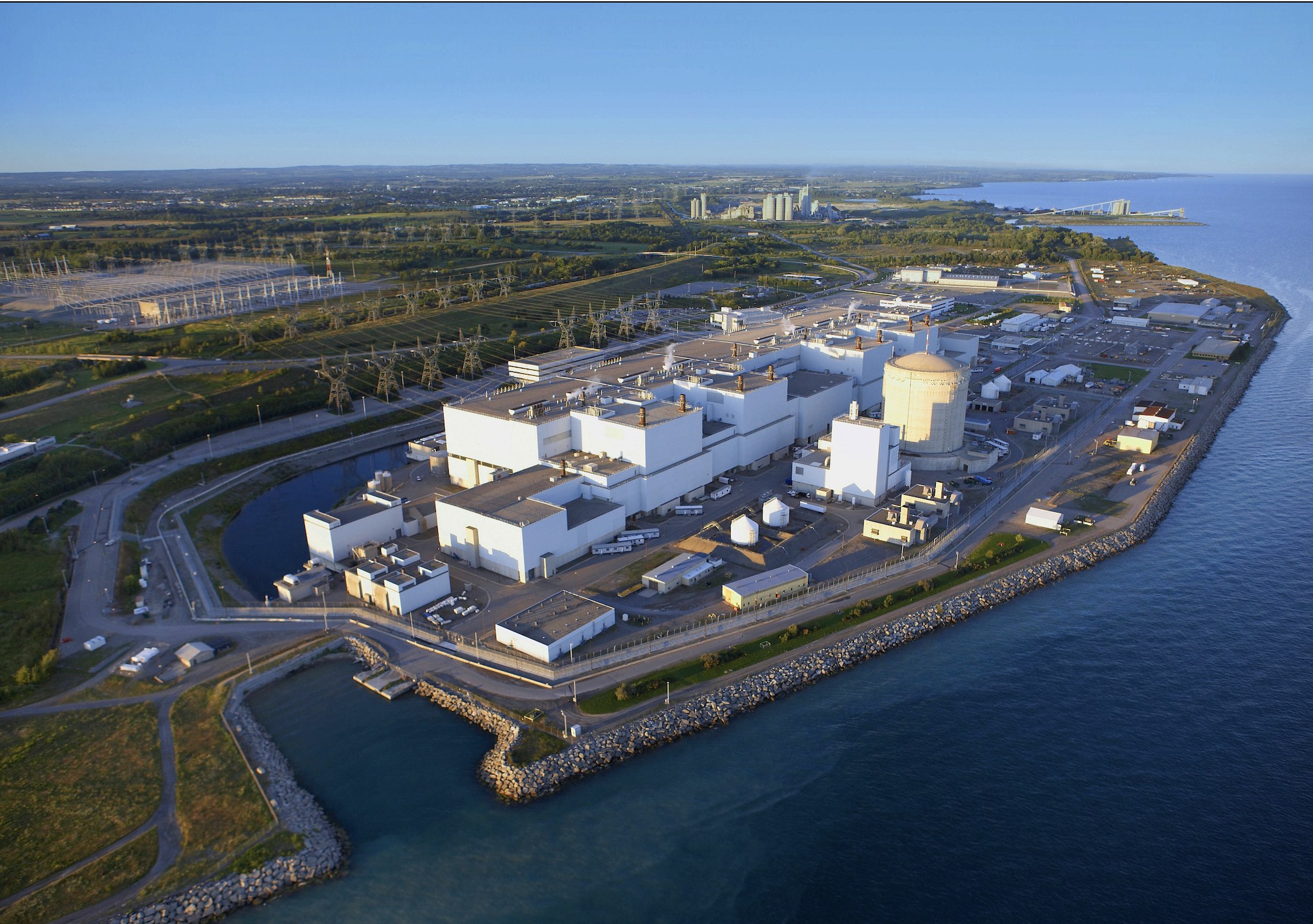
Assuming that OPG’s chosen design – the 300-megawatt BWRX-300 proposed for the Darlington nuclear site – is the one to be deployed widely, then around 70 SMR units would need to be built and operating effectively on the grid between 2030 and 2050. The BWRX-300 design is yet to be even approved by any safety regulator anywhere in the world.
But the report has an even more serious problem: economics. Nuclear power cannot compete economically, which is why its share of global electricity generation has declined from 17.5 percent in 1996 to 9.8 percent in 2021. Because SMRs lose out on economies of scale, they will produce even more expensive electricity.
The CER’s scenarios for nuclear power are based on the Electricity Supply Model, meant to calculate “the most efficient and cost-effective way to meet electricity demand in each region.” Such models are widely used in energy analysis and policy making but their utility depends on the validity of the assumptions used; garbage in, garbage out.
Two key parameters underlie the report’s scenarios—the capital cost of an SMR and how that cost evolves with time. The CER’s assumptions in the two Net Zero scenarios are that a SMR costs $9,262 per kilowatt in 2020, falling to $8,348/kW by 2030, and to $6,519/kW by 2050. Both these assumptions are ridiculously out of touch with the real world.
Consider the CAREM-25 SMR designed to feed 25 megawatts of electricity into the grid, being built in Argentina since 2014. Its original cost estimate of $446 million (2014 US dollars), has escalated significantly since then, but even using these original costs, the project costs nearly $30,000 per kilowatt in 2022 Canadian dollars.
The NuScale design, arguably the closest to deployment in the United States, has been in development since 2007 with the build not yet begun. The January 2023 cost estimate for six NuScale SMRs with a total capacity of 462 megawatts is $9.3 billion, or over $26,000 per kilowatt in Canadian dollars.
Finally, the cost of the 5-megawatt Micro Modular Reactor Project at Chalk River in Ontario was estimated by the proponent in May 2020 to be between $100 and $200 million. In 2022 Canadian dollars, that works out to $22,000 to $44,000 per kilowatt.
In other words, the CER’s cost assumptions are wild underestimates, 2.5 to four times lower than the current evidence.
The second incorrect assumption is that costs will decrease with time. Both in the United States and France, the countries with the highest number of nuclear plants, the trend was the opposite: costs went up, not down, as more reactors were built. In both countries, the estimated construction cost of the most recent reactors being built—Vogtle in the United States, and Flamanville-3 in France—have broken new records.
We need government organizations to do better. The climate problem is too serious for such unrealistic modelling exercises. Wishful thinking will only thwart our ability to act meaningfully to lower emissions rapidly.
An earlier version of this commentary was published by The Hill Times.
M.V. Ramana is the Simons Chair in Disarmament, Global and Human Security and professor at the School of Public Policy and Global Affairs, University of British Columbia. Susan O’Donnell is adjunct research professor and primary investigator of the CEDAR project at St. Thomas University in Fredericton.