

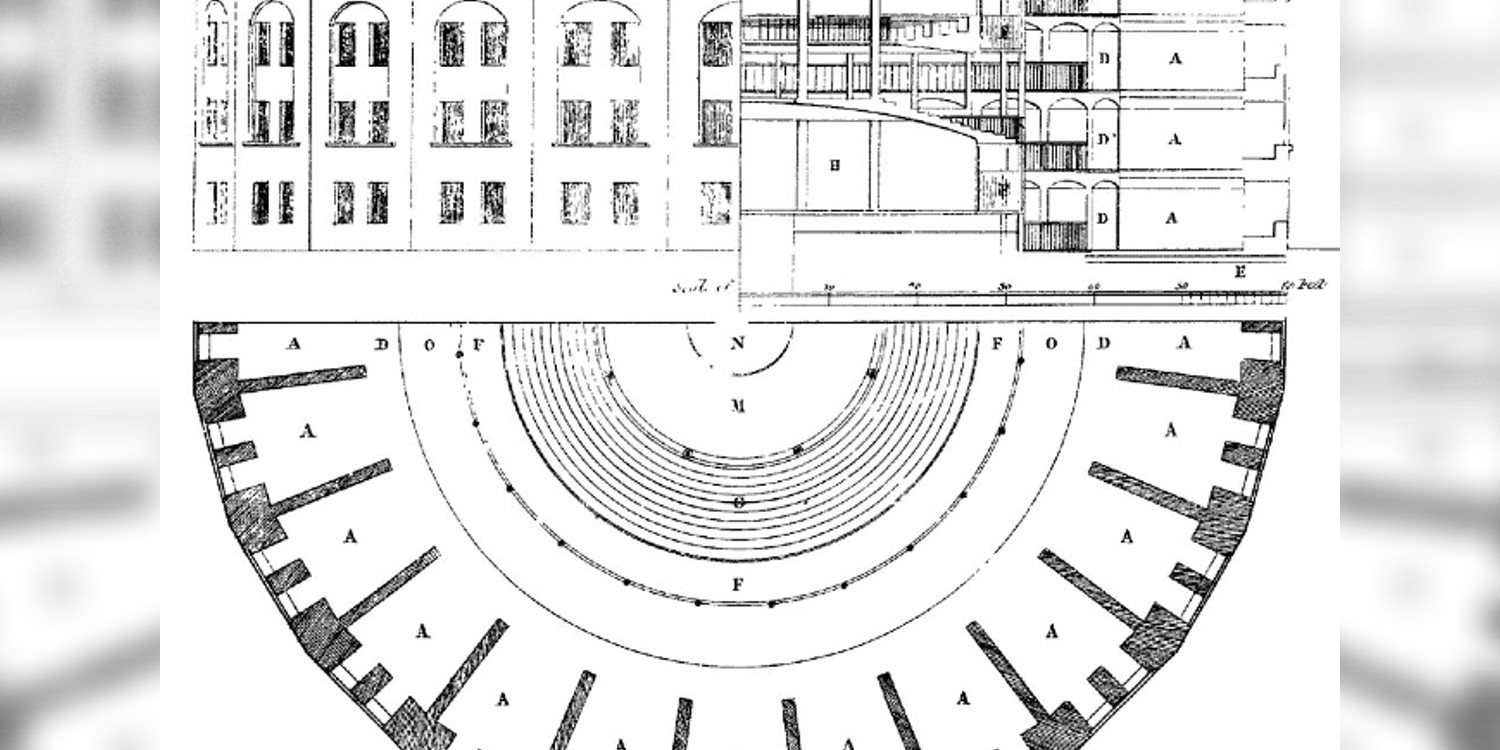
In December 2021, officials in the New Brunswick government announced the planned construction of a new jail. The jail’s price tag recently jumped from $38 million to $42 million. According to the CBC, officials also fudged the numbers to make the province’s prison system appear overcrowded. The expenditure didn’t appear on either of the Conservative Party’s 2018 or 2020 platforms.
In March 1971, French philosopher, historian, and prison abolitionist Michel Foucault published a manifesto in the literary magazine Esprit, castigating France’s carceral state and announcing the formation of the Groupe d’Information sur les prisons, a collection of activists and professionals committed to revealing how and why France’s prison system functioned.
“They tell us that the system of justice is overwhelmed,” Foucault wrote. “We can see that.”
But what if it is the police that have overwhelmed it? They tell us that prisons are over-populated. But what if it was the population that was being over-imprisoned? Little information is published on prisons. It is one of the hidden regions of our social system, one of the dark zones of our life. We have the right to know; we want to know.
It would be a mistake to hinge the jail’s construction on a so-called “business case.” Historically, prisons have not reduced crime, but actively produced it. As scholar Angela Davis notes, there will always be a “business case” for prisons. Prisons create jobs and infrastructure by incentivizing crime and violence and producing government surpluses from the slave-like labour of racialized communities, disabled people, and the working-class.
Origins of the carceral state
The history of the prison ought to be linked to the histories of similar institutions: residential schools, asylums, and educational institutions, for example.
In the late nineteenth century, Canada’s Second Industrial Revolution expelled a significant proportion of the working-class from the labour process, creating a massive pool of the unemployed. As historian Alvin Finkel notes, experts and professionals erected institutions and social policies designed to “reform” deviant or defective working populations, often for the benefit of private business.
Criminologists Andrew Woolford and James Gacek have correctly identified “Indian Residential Schools” as carceral institutions. For nearly two centuries, across the country, Indigenous children were taken from their families, imprisoned for most of the year, and violently assimilated under the constant threat of solitary confinement.
In their view, malnutrition, illness, and physical, sexual, and emotional abuse were not unintended consequences of an otherwise benevolent system, but inherent features of a carceral network tied to the ongoing, genocidal tendencies of settler colonialism. Student labour quite literally fuelled the institutions, as Indigenous children were forced to till the land, produce food, and maintain the schools for the benefit of white settlers.
Tellingly, at the Qu’Appelle Industrial School in Saskatchewan, Father Joseph Hugonard, the school’s first principal, once described the institution’s nearly 20 per cent death rate as “something to be proud of.”
But carceral violence extends beyond the Indian Residential School System proper. For decades, critical theorists of disability have argued that the birth of industrial capitalism actively created “disability” by ejecting a sizeable portion of the working-class from the labour process: physically, intellectually, and sensorially disabled people. By depressing wages and increasing labour competition, disabled people were used by big business to turn a profit.
At the time, Edgerton Ryerson, a chief contributor to Canada’s Indian Residential School System, urged the province of Ontario to open residential schools for blind, deaf, and otherwise disabled Canadians. Students were segregated based on their physiology, taken from their families, and kept at school for most of the year. They were subjected to systemic abuse: sexual exploitation, beatings, and emotional violence. In recent years, former students have likened their experiences to those of Indian Residential School survivors.
At institutions like the Huronia Regional Centre, originally named the “Orillia Asylum for Idiots,” intellectually disabled people were subjected to routine violence and sexual exploitation at the hands of social workers. Similar institutions for deaf and blind individuals operated in British Columbia, Nova Scotia, and New Brunswick, and many of them are still open today.
Producing violence
It would be a mistake to argue that residential schools — and strategies of residential schooling — have ended. Carceral violence is still endemic within Canadian society, and building more prisons won’t reduce violence, but incentivize it.
According to the Government of Canada, the proportion of Indigenous people in federal prisons surged from 20 per cent to 28 per cent between 2008 and 2018.
In New Brunswick, between 2013 and 2014, Indigenous adults made up 10 per cent of the jailed population, 10.5 per cent of the remanded population, and 10 per cent of the temporarily detained population. Indigenous people were more likely to be jailed younger, denied bail more frequently, and granted parole far less often than white settlers.
Similar data does not yet exist for disabled people in the Canadian context. But, in the United States, according to a 2016 Survey of Prison Inmates, 66 per cent of incarcerated people self-reported a disability. Respondents were also for more likely than able-bodied people to have previously lived in similar institutions like juvenile detention facilities and psychiatric hospitals.
In Ontario, incarcerated people are more than twice as likely to have an intellectual disability than non-incarcerated people. Carceral institutions like residential schools, educational institutions, and asylums could therefore be reasonably described as “feeder institutions” for the prison-industrial complex.
In Canadian prisons, sexual violence “pervasive but underreported,” according to a 2019-20 report from the Office of the Correctional Investigator. What’s more, Indigenous people, women, and gender and sexual minorities are far more likely to experience sexual violence than settlers, men, and cisgender and heterosexual individuals. Strip searches and cavity searches also foster cultures of state-sanctioned abuse by legalizing sexual violence in an institutional context.
In short, prisoners are treated as nonhumans. They live a slow death, confined to a mode of existence that Italian philosopher Giorgio Agamben once described as “bare life.”
Prisons create so-called criminals by eliminating people’s humanity through law, relegating them to the margins of society, and punishing them through both formal and informal channels. Reducing levels of “crime,” violence, and abuse in Canadian society means tackling the legacies of settler colonialism and disablement while ensuring an aggregate reduction in the state’s ability to incarcerate those deemed deviant, defective, and socially undesirable.
Premier Blaine Higgs, explain yourself. Why does New Brunswick need another prison?
Harrison Dressler researches Canadian history, disability, labour, and the environment at Queens University. A settler, he lives on the traditional territory of the Haudenosaunee and Anishinaabek.