


New Brunswick readers will be interested to know that a novel has just been published in Quebec about the Irving family’s hegemony.
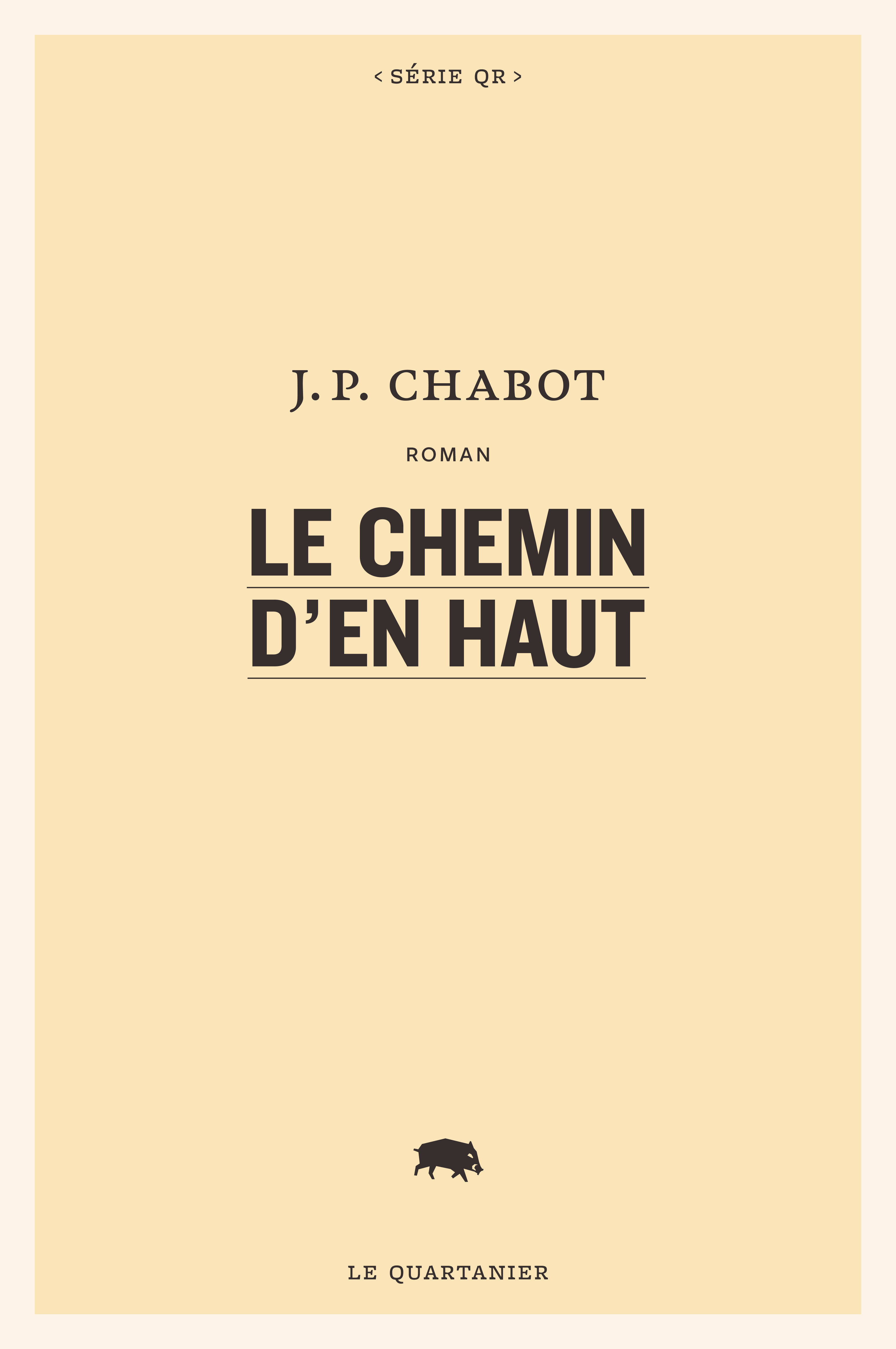
Le Chemin d’en haut (The High Road) by Jean-Philippe Chabot, published by Le Quartanier this year, tells the story of the obstacles faced by the heir to a family home located in the Gaspé Peninsula, on a site coveted by a consortium of which Irving is a member.
We are not here to criticize literature, nor will we dwell on the author’s trashy style, on his insightful study of the language of everyday life necessary for its reproduction, nor on the loquaciousness of the damned of the earth, the good-for-nothings and other shady characters, nor on the fate of the characters, who are as tried as they are haggard.
It is rather on issues of verisimilitude that we now turn. For Chabot, it is possible that a conglomerate that appears allegorically as “The Company,” and with which an entity bearing the name of Irving is associated, will brutally expropriate residents in the path of a gas pipeline and even resort to local mafias to eliminate, in the brutal sense, the very last opposition.
The meaning of the plot unfolds throughout the narrative. The hero finds the beans his father left behind when he died in a snowmobile accident after going missing for a long time. It is by getting to the bottom of things that he understands the troublemaker role played by his father, to whom he spoke so little.
In moments of brilliance, socio-political commentary emerges in the text, interrupting the narrative. The writer’s lucidity not only adds to the cruelty of the story, but also gives its general modality the everyday violence of the community. How can one become a policed subject in a cynical universe that is globally governed by corruption and class violence? For example, about highway 85 which links the Lower St. Lawrence and New Brunswick: the reader gets some sadly truculent pages of the disillusioned considerations on the widening in fits and starts because of the pace of deadlines. At another point, the reader twitches when the author offhandedly exposes a gas company’s stratagems to make its own project fail in order to cash in on state compensation.
But these are only interludes. The pièce de résistance is revealed to us when the author, unraveling a plot with an end I am now about to divulge, weaves together the threads of the story by fastening the small one to the larger one.
And the big story is, first of all, the one that ‘The Company’ shapes for itself in order to make it happen to others.
This company’s corporate name and raison d’état is the acronym Cie (the abbreviation for company in French), for Clean Irving and Enbridge. Pages 136 and 137 read as follows:
─ Wait, let me get this straight. The Company is Enbridge and Irving. Irving, the gas stations?
─ Yes. Irving, the gas stations, Irving, the biggest refinery in the country, in Saint John.
─ If you’re going to produce gas, you might as well sell it yourself, right?
─ They figured that for the trees too: the foresters, the sawmills, the construction companies, the hardware stores, the paper mills, the printing plants, the newspapers. They own almost all the newspapers in New Brunswick [Editor’s note: Since then, they have been sold to Postmedia].
─ Surely that’s not legal.
─ Well, yes, it’s legal. They write the laws.
To complete this overall picture, politics is added first.
A “tank salesman” and “facilitator” for the company, the Minister of the Environment makes sure that people knock on doors to sell the project in an ecological way while at the same time arguing for schizophrenic national prosperity. He argues to legally expropriate —according to the law he guards— the undesirable person who obnoxiously lives on the gas pipeline’s prospective path.
In the end, it is not clear whether the pipeline is intended to transport dirty oil from Alberta, gas extracted in a polluting manner or pseudo-green energy such as hydrogen. And, this confusion in the narrative resembles the marketing propaganda that confounds the mind rather than enlightening it. And, the rules of governance call for employment contracts for residents living on the edges of the designated strip of land, almost like work camps. That is, “activists who are competent or qualified to work for the company.”
Finally, a judge intervenes in the story to put the Company’s view of the world into law. All are of this school of thought: “The lawyers explained to me that, as far as the judge was concerned, I either filled out the forms or I would find myself in jail.”
I’ve simplified the steps of an intrigue explaining the knot of relations between the protagonist and his parents’ found community.
Any resemblance to this work of fiction would be fortuitous and the sole fact of chance: the proverbial warning no longer holds. If the writing remains fictional, it is because it probes possibilities as much as proven realities and places them on the same level, according to what seems relevant to the writer. Then, it is up to the company to defend itself against its own demons.
Alain Deneault is a professor of philosophy at the Université de Moncton and author of Bande de colons: Une mauvaise histoire de classe (Lux, 2020).
This commentary was first published in French by COOP Média NB.