• “I can’t believe I get to live in a place like this”: Deborah Carr
  • “Our rural roads are dangerous”: Cheryl Johnson
  • “Scarlet flowers in a messy garden:” Rick Roth
  • 2021 CUPE strike
  • About
    • History
    • Join us / Rejoignez-nous
  • Archives
  • Brian Beaton Annual Prize in Journalism for Justice / Le prix annuel de journalisme Brian Beaton pour la justice
  • Calendar
  • Comment soumettre votre article
  • Contact
  • Front Page
  • Garlic and optimism by Stephanie Coburn
  • google site verification – do not delete
  • Join the Co-op / Donate
  • Local Journalism Initiative
  • Markets and inter-generational goodness by Teri McMackin
  • Nuclear energy in New Brunswick
  • On hanging on and being hopeful: Deborah Carr
  • Our Team / Notre Équipe
  • Posts Page
  • Privacy policy
  • Share a Story
  • Subscribe/ S’abonner
  • The Brief / En Bref
  • The hills of Penobsquis by Beth Nixon
  • The NB debrief with Tobin Haley
  • Devenir membre / Faire un don
  • Donation Confirmation
  • Donation Failed
  • Donor Dashboard
NB Media Co-op
No Result
View All Result
No Result
View All Result
NB Media Co-op
No Result
View All Result
Home Indigenous

Elder leads medicine walk for young minds

Students learn about Mi’gmaq culture, traditional healing plants on cultural teaching hike

by Kirsten Leclaire-Mazerolle
July 31, 2022
in Indigenous, New Brunswick
0
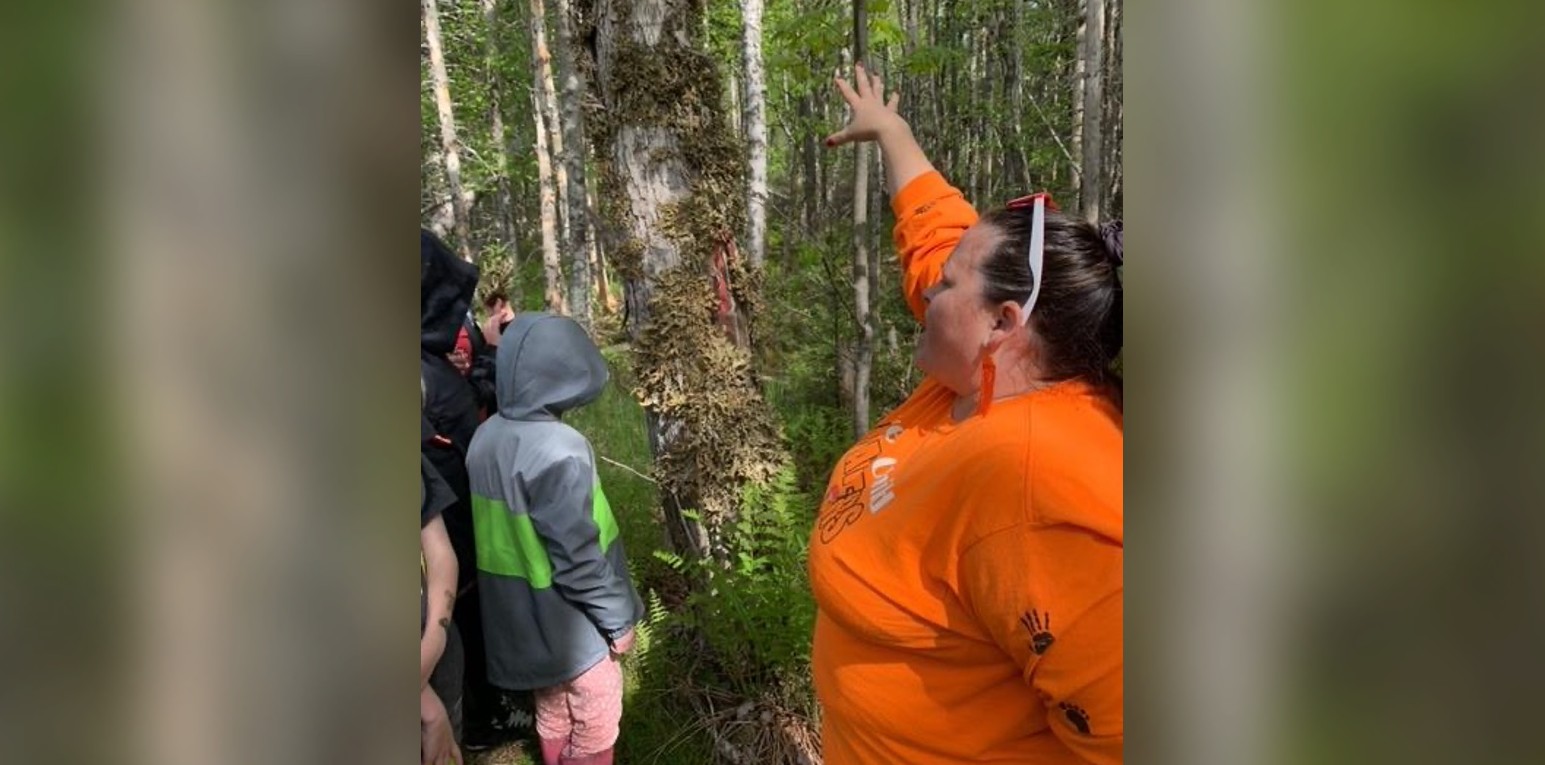
Elder leads medicine walk for young minds

Elder Nicole Dubé teaches the students at Dorchester Consolidated School about Indigenous traditional medicinal uses of plants. Photo: Kirsten Leclaire-Mazerolle

0
SHARES
0
VIEWS

Fort Folly First Nation has developed an innovative relationship with Dorchester Consolidated School, an Anglophone K-8 school in rural Southeastern New Brunswick, hosting students for teaching hikes on the Fort Folly Medicine Trail.

Fort Folly Elder Nicole Dubé has developed the cultural teaching hikes over the last five years. Grade 5-8 students recently experienced a walk co-organized by Erin Hansen, an art, health, and physical education teacher at Dorchester Consolidated.

As a mother of students involved, I was invited to participate in the hike with Elder Dubé and Hansen. The day provided an opportunity for students to learn about Mi’gmaq culture and the traditional plants they use for healing.

The hike is a prime example of practical ways in which First Nations communities are working with mainstream educators to build understanding of local Indigenous knowledge holders and ways of life.

On the hike last month, Elder Dubé gave a warm welcome to students and Hansen passed a tobacco tie offering for the knowledge that she would pass on to us. With this exchange, our adventure commenced.
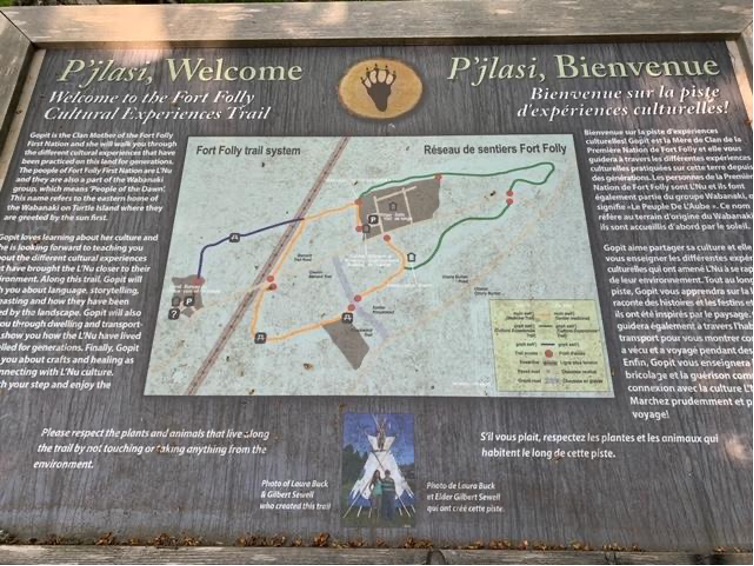
The first of many signs on the Fort Folly Medicine Trail that depict Mi’gmaq culture and history. Photo: Kirsten Leclaire-Mazerolle

As Elder Dubé led us along the forest trail, she explained to students that Mi’gmaq language is full of descriptors, and that there may be numerous names for a single plant.

The mass of blackflies and mosquitoes did not stop the curiosity of these children as they busted out with questions throughout the walk. Perhaps surprisingly their number one question was, is this plant edible? Elder Dubé shared her knowledge of some of the edible parts of plants and trees, and how to get to the delicious parts. Some, she noted, even replicated chewing gum. The children learned medicinal uses of plants, such as some that cured scurvy of weary travelers.

Questions of safety were also broached, and what to do if you ever find yourself lost in the forest. Keep an eye out for bears, Elder Dubé explained, as they are the best scavengers of edible berries and plants. Observing where bears have visited might be a good way to find food. Bears were the subject of much traditional storytelling.

The students learned stories about Turtle Island (North America) and Glooscap, a sort of cultural hero who brought knowledge of fishing nets and canoes. The students were fascinated to learn that beavers were as big as bears at one time. This meant that Glooscap was also large, and Elder Dubé told the children of the giant statue of Glooscap in Nova Scotia.
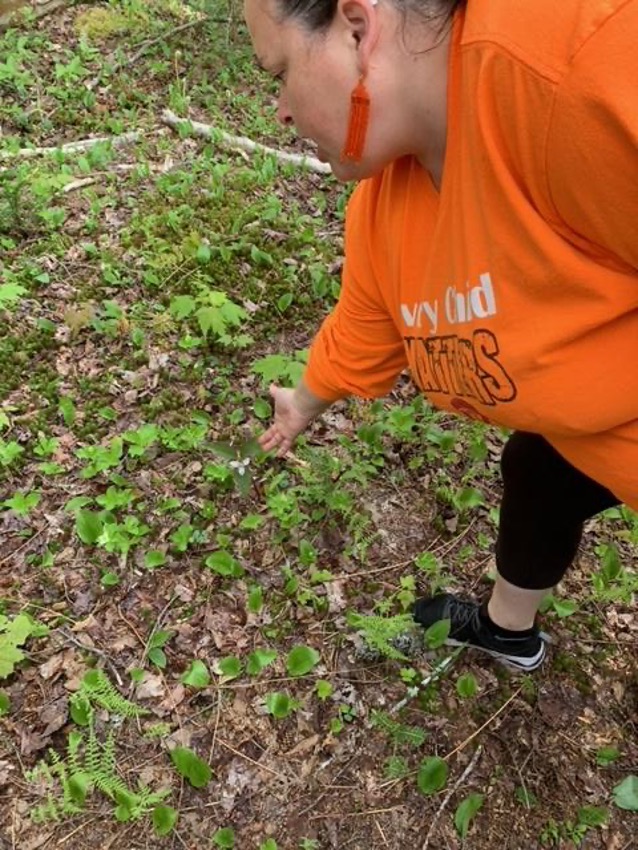
Elder Nicole Dubé showing grade 5 to 8 students flowers and explaining their uses. Photo: Kirsten Leclaire-Mazerolle

In connection with plants that were on the path, seasonal migratory practices of many Indigenous people were also discussed. Here Elder Dubé showed how there are inner layers of birch bark that Indigenous people used to make boats, tied together with the sticky sap of other trees. These materials made the boats light enough to carry across land areas, and then back into the rivers to migrate to where their destination for the coming spring or winter season. Elder Dubé explained that for Fort Folly, the Beaumont-Memramcook migratory stop point was the nearest known location of this seasonal round.

One of the most memorable moments on this hike was at a magnificent spruce tree intertwined with a birch tree. Elder Dubé used these trees to teach the children about the beautiful ways of “two-eyed seeing,” and the role of Indigenous knowledge holders. She conveyed this by talking about how the birch and spruce trees teach all of us to share and hold each other up. How all this knowledge is “not knowledge for us to keep, but rather it’s for us to share.” These words represented a cultural value held by all Indigenous peoples.

Two-eyed seeing is the combination of two worlds. By combining Western science and Indigenous science, we avoid the domination and assimilation of one to the other. Rather, as we learned, these two forms of science complement each other.

The young students had the privilege of experiencing first-hand the method of two-eyed seeing, something that not many children have a chance to learn about. They received the scientific knowledge of these plants, and also got to experience cultural wonders, like the bonded spruce and birch and how they hold one another up. This is the kind of outlook that all of us should walk away with, to learn with your mind and to understand with your soul.

Kirsten Leclaire-Mazerolle, from Natoaganeg First Nation, is a researcher and writer working out of the Human Environments Workshop (HEW) funded by RAVEN.
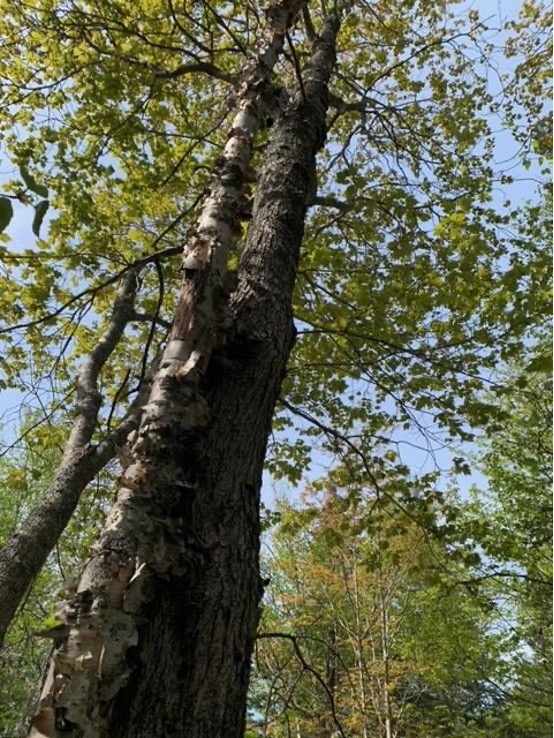
The spruce and birch tree, holding one another up. Photo: Kirsten Leclaire-Mazerolle
Tags: Dorchester Consolidated SchoolElder Nicole DubéFort Folly First NationKirsten Leclaire-Mazerolle

Recommended

No Content Available

Site Links

  • Log in
  • Entries feed
  • Comments feed
  • WordPress.org
  • “I can’t believe I get to live in a place like this”: Deborah Carr
  • “Our rural roads are dangerous”: Cheryl Johnson
  • “Scarlet flowers in a messy garden:” Rick Roth
  • 2021 CUPE strike
  • About
  • Archives
  • Brian Beaton Annual Prize in Journalism for Justice / Le prix annuel de journalisme Brian Beaton pour la justice
  • Calendar
  • Comment soumettre votre article
  • Contact
  • Front Page
  • Garlic and optimism by Stephanie Coburn
  • google site verification – do not delete
  • Join the Co-op / Donate
  • Local Journalism Initiative
  • Markets and inter-generational goodness by Teri McMackin
  • Nuclear energy in New Brunswick
  • On hanging on and being hopeful: Deborah Carr
  • Our Team / Notre Équipe
  • Posts Page
  • Privacy policy
  • Share a Story
  • Subscribe/ S’abonner
  • The Brief / En Bref
  • The hills of Penobsquis by Beth Nixon
  • The NB debrief with Tobin Haley
  • Devenir membre / Faire un don
  • Donation Confirmation
  • Donation Failed
  • Donor Dashboard

© 2026 JNews - Premium WordPress news & magazine theme by Jegtheme.

No Result
View All Result
  • “I can’t believe I get to live in a place like this”: Deborah Carr
  • “Our rural roads are dangerous”: Cheryl Johnson
  • “Scarlet flowers in a messy garden:” Rick Roth
  • 2021 CUPE strike
  • About
    • History
    • Join us / Rejoignez-nous
  • Archives
  • Brian Beaton Annual Prize in Journalism for Justice / Le prix annuel de journalisme Brian Beaton pour la justice
  • Calendar
  • Comment soumettre votre article
  • Contact
  • Front Page
  • Garlic and optimism by Stephanie Coburn
  • google site verification – do not delete
  • Join the Co-op / Donate
  • Local Journalism Initiative
  • Markets and inter-generational goodness by Teri McMackin
  • Nuclear energy in New Brunswick
  • On hanging on and being hopeful: Deborah Carr
  • Our Team / Notre Équipe
  • Posts Page
  • Privacy policy
  • Share a Story
  • Subscribe/ S’abonner
  • The Brief / En Bref
  • The hills of Penobsquis by Beth Nixon
  • The NB debrief with Tobin Haley
  • Devenir membre / Faire un don
  • Donation Confirmation
  • Donation Failed
  • Donor Dashboard

© 2026 JNews - Premium WordPress news & magazine theme by Jegtheme.

X
Did you like this article? Support the NB Media Co-op! Vous avez aimé cet article ? Soutenez la Coop Média NB !
Join/Donate