

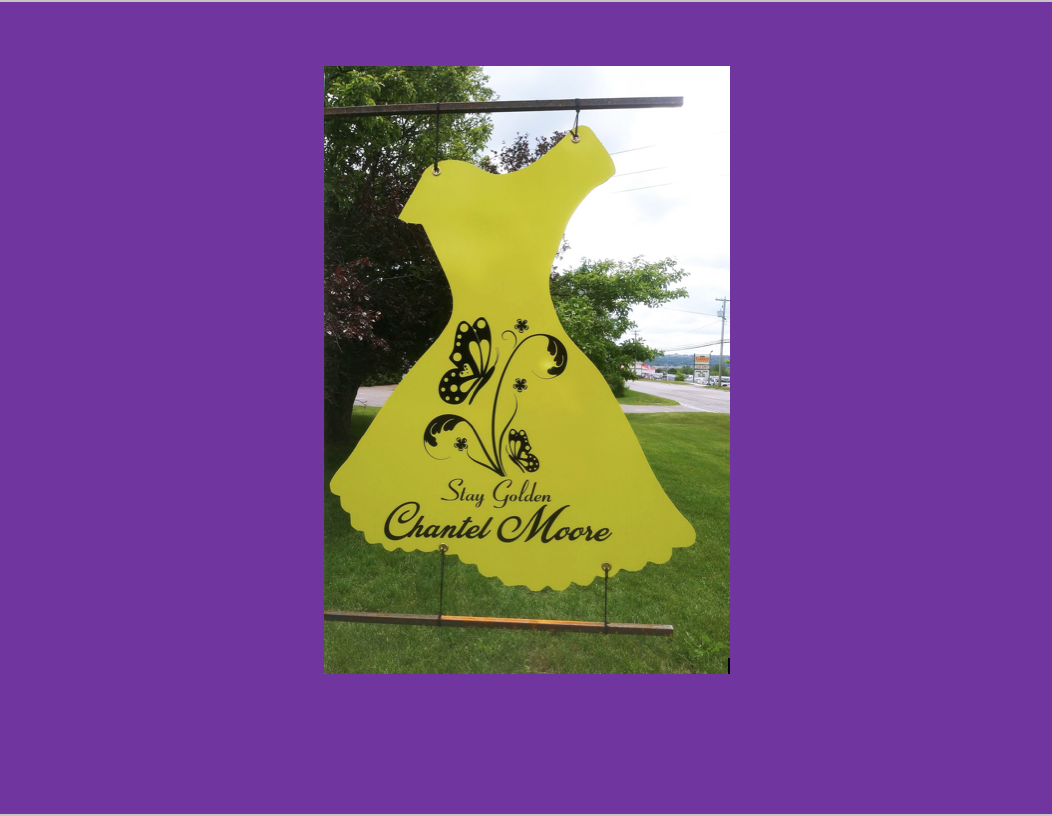
June 4th marks the one year anniversary of the death of Chantel Moore, who was killed at the hands of an Edmundston, New Brunswick police officer.
Const. Jeremy Son was called to Moore’s location to conduct a wellness check on the morning of June 4, 2020. This was in response to a request by a friend of Moore’s, who was concerned that she was being harassed and receiving worrisome messages on social media.
The officer who shot the 26-year-old mother, five times at close range, three times in the back, has yet to be charged. The officer’s name was never released until a CBC investigation uncovered it.
After the incident the officer was removed from duty for three weeks. He was then returned to work, this time in an administrative position.
A police watchdog agency from Quebec was in charge of the inquiry into the shooting death of the Tla-o-qui-aht First Nation woman. Although the findings have yet to be released publicly, the watchdog group cleared the police of any wrongdoing.
Just over a week after the death of Chantel Moore, a member of the Metepenagiag First Nation in New Brunswick, Rodney Levi, was also killed during a wellness check. In his case the incident involved the RCMP.
The Bureau des Enquêtes Indépendantes, Quebec’s police watchdog, were in charge of investigating this death as well. Again, the Bureau rejected the notion of police wrongdoing. This, despite the fact that Rodney Levi was in a mental health crisis at the time.
There are some things to consider when deciding whether it might be inappropriate and inadequate to engage a police watchdog group from a province that takes the official line that there is no systemic racism in that province, especially in light of a report by lawyer and professor Fannie Lafontaine on transparency within the Bureau.
The opening statement of the Independent Civilian Observer report states, “This report is the culmination of five years of work at the intersection of two fundamental societal issues: criminal investigations involving police officers and the resulting fears of bias and impunity, and the broken relationship of trust between Indigenous peoples and police services.”
Last year, the Atikamekw Nation asked the Province of Quebec to adopt Joyce’s Principle, created in November 2020, in response to the death of 37-year-old Joyce Echaquan. The mother of seven died in a Joliette, Quebec hospital. She filmed herself on Facebook Live asking for help from a nurse and orderly, who stood by as she struggled, hurling racist remarks at her. Wednesday, June 2nd, saw the culmination of a coroner’s inquiry into her death.
Joyce’s Principle is “a call to action and a commitment from governments to end an intolerable and unacceptable situation.” Joyce’s Principle asserts that “Indigenous people have an equal right to the highest standard of physical and mental health” in keeping with the United Nations Declaration on the Rights of Indigenous Peoples (2007), Article 24.
The Quebec National Assembly rejected the proposal based on their view that there is no such thing as system racism within Quebec.
All of this comes as the nation grapples with the discovery led by the Tk’emlúps te Secwépemc Language and Culture Department of the unmarked graves of 215 Indigenous children at the site of a former residential school in Kamloops, British Columbia.
As well, this week sees the unveiling of an arguably impotent and long-awaited response to the recommendations of the Inquiry into Missing and Murdered Indigenous Women and Girls (MMIWG).
In a video interview with Toronto’s CP24 News Channel, Pam Palmater, a Mi’kmaw lawyer and professor at Ryerson University (X University), concludes that the MMIWG plan doesn’t recognize the failure of the federal government to do anything about the genocide.
After these three deaths, calls have gone out from community members and advocates for a national inquiry into police brutality and mental health, and systemic racism in the various systems of justice.
But the Inquiry into Missing and Murdered Indigenous Women and Children, as well as the discovery of the unmarked graves requires us to adjust our focus.
When will the facts be enough to call these examples of injustice against Indigenous populations what they are? These are ongoing systemic acts perpetrated by a nation that was founded on a convention and pact of genocide.
Here in Mi’kma’ki, some of us are questioning our own tolerance for systemic racism and environmental injustice.
This article was first published online by the Nova Scotia Advocate on June 2, 2021.