David Frank: This is a letter written in 1945 by a young New Brunswick woman. Thelma O’Ree was one of the older sisters in a large family who lived on Charlotte Street in Fredericton. In the summer of 1956, she was the one who answered the door when the not yet legendary hockey coach Punch Imlach came looking to sign up her youngest brother for the Quebec Aces. The rest is history. Willie O’Ree became a star for the Aces, and in January 1958 he was called up by the Boston Bruins, becoming the first Black player in the National Hockey League. The following document is from a few years earlier, written at the end of the Second World War, when Willie was not yet ten years old. In sending this letter to the local daily newspaper, 25-year old Thelma wanted to draw attention to the deplorable conditions facing young Black men who were returning from wartime service to face unresolved problems of racial discrimination at home. Her theme was that it was time for Canadian society, and Fredericton in particular, to start living up to the ideals of the war for democracy.
As Bill Spray has shown in The Blacks in New Brunswick, originally published in 1972, New Brunswick has a provincial Black community with deep roots in the Loyalist province — and a history of struggles equally as long. And Thelma O’Ree’s letter confirms that the community produced individuals who were prepared to voice their concerns and their hopes. The letter was originally published in the Daily Gleaner on 28 August 1945 under the title “The Color Line”. It was later reprinted in the local alternative newspaper of the time, True Democracy. Some of the language may be dated, and the letter is presented here in abbreviated form. But the message could not be more clear. In 1945, Black lives already mattered.
Sir: —
I have had the opportunity within the past 10 days of speaking to a number of Canadian colored soldiers from New Brunswick and Nova Scotia. One had been a prisoner of war in a German prison camp for 11 months. Others have served overseas from four to six years. . . .
I have been told by some of these boys of the very fine treatment received by them in Europe, especially Scotland and England, of the very fine homes they have visited, and all the boys who have come back tell us about the absence of prejudice, and particularly in Europe. We can very well understand why there will always be an England and there will always be a warm spot in the hearts of our soldiers for the European people.
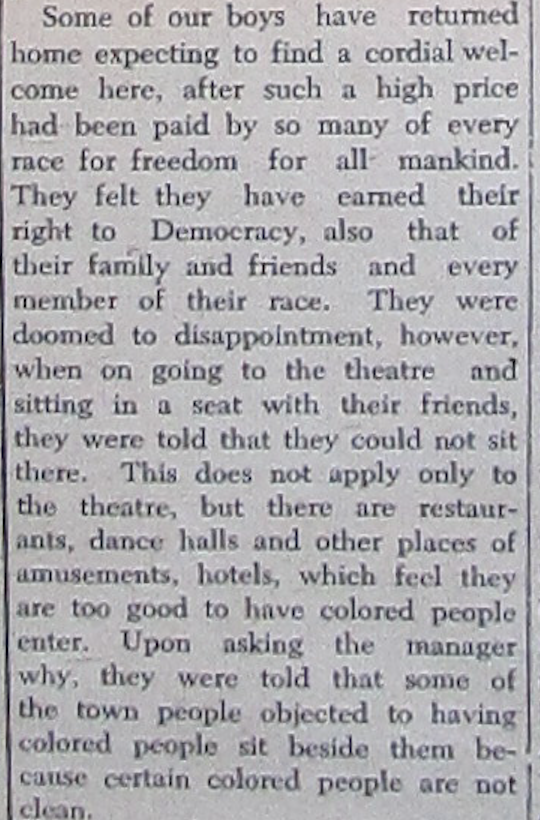
Some of our boys have returned home expecting to find a cordial welcome here, after such a high price had been paid by so many of every race for freedom for all mankind. They felt they have earned their right to Democracy, also that of their family and friends and every member of their race. They were doomed to disappointment, however, when on going to the theatre and sitting in a seat with their friends, they were told that they could not sit there. This does not apply only to the theatre, but there are restaurants, dance halls and other places of amusements, hotels, which feel they are too good to have colored people enter. Upon asking the manager why, they were told that some of the town people objected to having colored people sit beside them because certain colored people are not clean. . . .
For the past four years or more our boys have been serving with the Canadian Army overseas. Some have gone through all the theatres of war, been honored by the Royal Family personally and have spent many months as German prisoners-of-war. Others have come on leave. Some will never come home. During this period our boys have had the privilege of meeting and have fellowship with some of the finest people in this world. Never once were they made to feel that because of their race they were inferior.
It was a wrench for the boys to leave the very real friends they had made over there, but they did look forward to coming home. It was therefore a heart-sickening experience to come back to the home town and find the same petty prejudices and discriminations against our race still existing. I am referring to the humiliating and degrading treatment we have had to contend with in our theatres, hotels, restaurants and places of amusement.
Some of the people do not wish us to mingle with them even in a public place. “Where is the freedom our boys fought for? Must we apologize for being as God made us?” Even in the prison camps of Germany, our boys were treated as equals with all races.
What does Democracy mean? When does it begin at home? We expect kicks and insults from the enemy but not from our home town folk. Where is the better world we were led to expect? How can we build a better world on such a foundation? Many of our boys have made the supreme sacrifice for what?
Respectfully,
Thelma O’Ree
Fredericton, N.B.