• “I can’t believe I get to live in a place like this”: Deborah Carr
  • “Our rural roads are dangerous”: Cheryl Johnson
  • “Scarlet flowers in a messy garden:” Rick Roth
  • 2021 CUPE strike
  • About
    • History
    • Join us / Rejoignez-nous
  • Archives
  • Brian Beaton Annual Prize in Journalism for Justice / Le prix annuel de journalisme Brian Beaton pour la justice
  • Calendar
  • Comment soumettre votre article
  • Contact
  • Front Page
  • Garlic and optimism by Stephanie Coburn
  • google site verification – do not delete
  • Join the Co-op / Donate
  • Local Journalism Initiative
  • Markets and inter-generational goodness by Teri McMackin
  • Nuclear energy in New Brunswick
  • On hanging on and being hopeful: Deborah Carr
  • Our Team / Notre Équipe
  • Posts Page
  • Privacy policy
  • Share a Story
  • Subscribe/ S’abonner
  • The Brief / En Bref
  • The hills of Penobsquis by Beth Nixon
  • The NB debrief with Tobin Haley
  • Devenir membre / Faire un don
  • Donation Confirmation
  • Donation Failed
  • Donor Dashboard
NB Media Co-op
No Result
View All Result
No Result
View All Result
NB Media Co-op
No Result
View All Result
Home Culture

Indigenous activism in El Salvador and Canada

by Sophie M. Lavoie
December 26, 2019
in Culture, Environment, Indigenous, New Brunswick
0
Indigenous activism in El Salvador and Canada

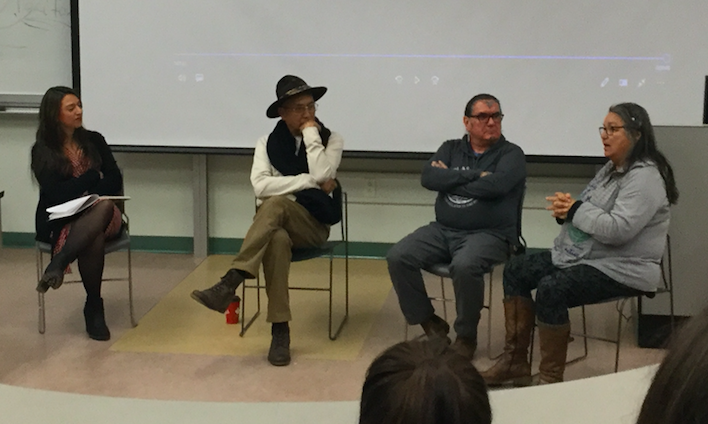
Panel at St. Thomas University on Nov. 19, 2019. L to R: Arianne Melara Orellana, Daniel Flores y Ascencio, Spasaqsit Possesom, Alma Brooks

83
SHARES
0
VIEWS

Indigenous activists from Canada and El Salvador discussed the similarities of their situations at a Wolastoq Grand Council event at St. Thomas University on Nov. 19.

Wolastoq Grand Council Chief Spasaqsit Possesom (Ron Tremblay) welcomed the crowd to Wolastoqiyik lands with the help of drummer Kyle Sacobie. Guest filmmaker Daniel Flores y Ascencio, from El Salvador, screened his 2002 film Ama: The Memory of Time. Spasaqsit Possesom met Flores y Ascencio at the United Nations in New York City.

Flores y Ascencio is of Nonualca Indian roots from south-central El Salvador.  Ama: The Memory of Time tells the personal story through one family’s experience of the 1932 “horrific genocide” of 30,000 people called “La Matanza” in El Salvador. For the filmmaker, it is a “portrait of a family that survived the 1932 genocide.”

Flores y Ascencio’s previous feature film, Homeland, portrayed young gang members who had been deported back to El Salvador. Many men who participated in the film were killed afterwards because of the violence in the country. Flores y Ascencio wanted to learn about the Indigenous situation when he was exiled in the US. He saw the reservations and told himself that “if that’s what democracy is” then he needed to reconsider what democracy he wanted. Flores y Ascencio affirmed that “democracies are a sham.”

The film was followed by a panel and discussion about Indigenous activism. Salvadorian student Arianne Melara Orellana, a recent graduate of St. Thomas University, introduced the discussion by saying: “I learned so much about the history of my country while being away from it.” Melara decried the “neo-colonialism” of corporations like mining companies in Latin America which she found in her research.

Flores y Ascencio declared that “the trauma [of the 1932 genocide] is still ingrained in our life, in our way of being.” El Salvador is entrenched in a cycle of violence that Flores y Ascencio wants to break because, for him, “trauma and fear are powerful tools.” For him, films can’t change the world, but their importance is to “bring awareness” about issues. He is currently working on a film on women and traditional medicines in El Salvador.

Wolastoqiyik grandmother Alma Brooks shared her experiences in Uruguay and Mexico where she had learned about ceremonial practices. “We had 100 years of war in my great-grandparents’ day” and “before the ink was even dry on the treaties” the British would be surveying the land.  Brooks said “they took our land.” For her, the film was very evocative: “our people carried that fear [the same as in the film] and didn’t fight back.” Brooks was also struck by “what a hold the Church has” on the people, no matter where: “it took our children and put them in the hands of the predators, paid by the government.”

Spasaqsit Possesom said that “after [Flores y Ascencio] shared his past, I decided to share my present.”  For Indigenous peoples in New Brunswick, “our communities follow a colonial government and are being directed and monitored by the federal government.” Communities “would be penalized” if they didn’t participate in the projects. Flores y Ascencio told Spasaqsit Possesom “that’s what happened to us 30 years ago.” For the Wolastoq Grand Council Chief, the Salvadorian prophesized (…) the downward spiral.” As proof of this spiral, Spasaqsit Possesom was especially critical of what he termed “the fourth level of government” created for the bands by the Trudeau government, making Indigenous communities “the bottom feeders.”

Flores y Ascencio also screened his film and had critical discussion with local activists in Elsipogtog and Sackville on Nov. 20.

Sophie M. Lavoie, a member of the NB Media Co-op Editorial Board, writes on arts and culture.

Tags: Alma BrooksEl SalvadorSophie M. LavoieSpasaqsit PossesomWolastoq Grand Council

Recommended

No Content Available

Site Links

  • Log in
  • Entries feed
  • Comments feed
  • WordPress.org
  • “I can’t believe I get to live in a place like this”: Deborah Carr
  • “Our rural roads are dangerous”: Cheryl Johnson
  • “Scarlet flowers in a messy garden:” Rick Roth
  • 2021 CUPE strike
  • About
  • Archives
  • Brian Beaton Annual Prize in Journalism for Justice / Le prix annuel de journalisme Brian Beaton pour la justice
  • Calendar
  • Comment soumettre votre article
  • Contact
  • Front Page
  • Garlic and optimism by Stephanie Coburn
  • google site verification – do not delete
  • Join the Co-op / Donate
  • Local Journalism Initiative
  • Markets and inter-generational goodness by Teri McMackin
  • Nuclear energy in New Brunswick
  • On hanging on and being hopeful: Deborah Carr
  • Our Team / Notre Équipe
  • Posts Page
  • Privacy policy
  • Share a Story
  • Subscribe/ S’abonner
  • The Brief / En Bref
  • The hills of Penobsquis by Beth Nixon
  • The NB debrief with Tobin Haley
  • Devenir membre / Faire un don
  • Donation Confirmation
  • Donation Failed
  • Donor Dashboard

© 2026 JNews - Premium WordPress news & magazine theme by Jegtheme.

No Result
View All Result
  • “I can’t believe I get to live in a place like this”: Deborah Carr
  • “Our rural roads are dangerous”: Cheryl Johnson
  • “Scarlet flowers in a messy garden:” Rick Roth
  • 2021 CUPE strike
  • About
    • History
    • Join us / Rejoignez-nous
  • Archives
  • Brian Beaton Annual Prize in Journalism for Justice / Le prix annuel de journalisme Brian Beaton pour la justice
  • Calendar
  • Comment soumettre votre article
  • Contact
  • Front Page
  • Garlic and optimism by Stephanie Coburn
  • google site verification – do not delete
  • Join the Co-op / Donate
  • Local Journalism Initiative
  • Markets and inter-generational goodness by Teri McMackin
  • Nuclear energy in New Brunswick
  • On hanging on and being hopeful: Deborah Carr
  • Our Team / Notre Équipe
  • Posts Page
  • Privacy policy
  • Share a Story
  • Subscribe/ S’abonner
  • The Brief / En Bref
  • The hills of Penobsquis by Beth Nixon
  • The NB debrief with Tobin Haley
  • Devenir membre / Faire un don
  • Donation Confirmation
  • Donation Failed
  • Donor Dashboard

© 2026 JNews - Premium WordPress news & magazine theme by Jegtheme.

X
Did you like this article? Support the NB Media Co-op! Vous avez aimé cet article ? Soutenez la Coop Média NB !
Join/Donate