

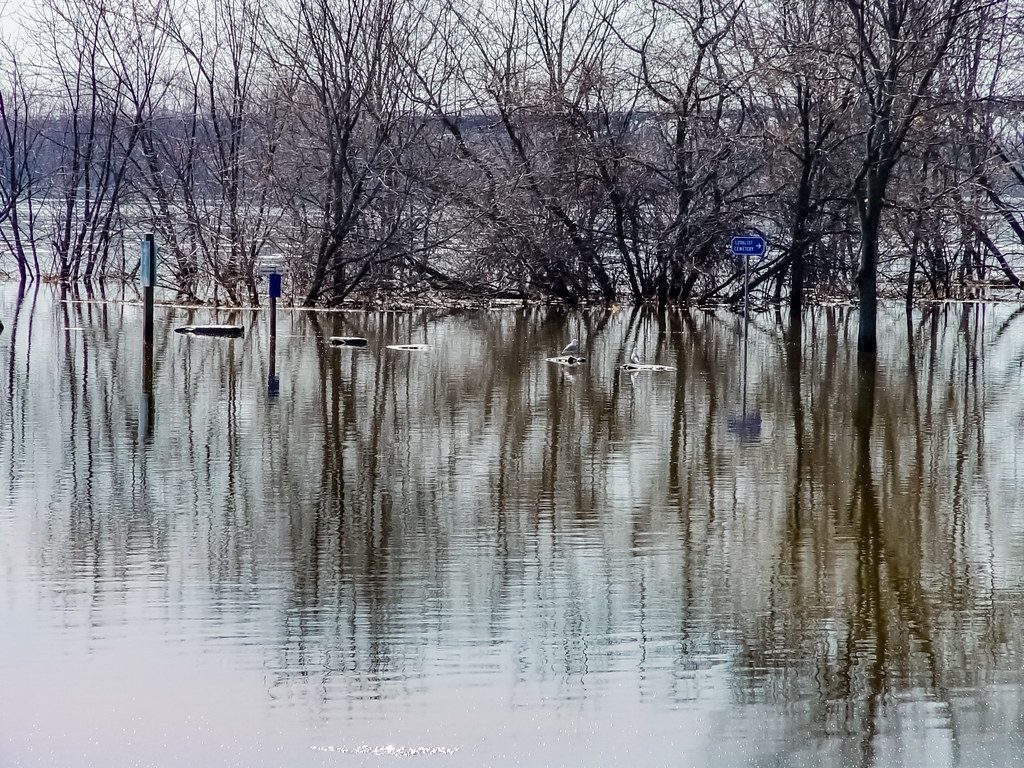
Recent flooding attributed to climate change has both devastated and drawn together communities along the Wolastoq (St. John River). Social science professor Julia Woodhall-Melnik, along with her research team at the University of New Brunswick in Saint John, is preparing a report on New Brunswick residents’ mental health and social capital as each was affected by the 2018 flood.
Woodhall-Melnik’s primary research centers on homelessness and housing instability. She is now investigating residential displacement in the wake of climate change, or “climate refugeeism.”
“A lot of people are really invested in this research, especially out here in the Maritimes,” says the social scientist. “People want to know more and understand more.”
According to Woodhall-Melnik’s preliminary report, drafted with fourth-year honours sociology student Caitlin Grogan, people who lose their housing during and following natural disasters can experience psychological symptoms like fatigue, depression, anxiety, grief, sleep disturbance, substance abuse, and Post-Traumatic Stress Disorder. These symptoms are often overlooked by post-disaster census data, which does not adequately consider the psychological impacts of displacement.
Physical displacement causes what has been termed “solastalgia,” or the emotional and mental effects of dislocation. Solastalgia can also be the result of an assault on or transformation of a home place. According to the American Psychological Association, displacement can leave communities “literally alienated, with a diminished sense of self and increased vulnerability to stress.”
Earlier this year, Woodhall-Melnik’s research team conducted semi-structured interviews with river community residents in Jemseg and the Kingston Peninsula areas and held focus groups with a number of residents who experienced displacement as a result of the 2018 flood.
Both the study’s interview and focus group participants reported feeling anxiety and mental exhaustion, and many found that navigating the provincial claims systems and finding the resources to begin home and property repairs added to their stresses.
Some residents, however, harboured a sense of betrayal. “They felt that the river they had grown to understand had betrayed them. We weren’t necessarily expecting that,” reflects Woodhall-Melnik.
The research team also found that while some resources were offered to displaced residents, these resources were not equally distributed. “At the municipal level, resources, responses, and service provision varied by town and city. In smaller, unincorporated areas, residents relied heavily on volunteer emergency responders and on provincial supports. In municipalities, such as Saint John and Fredericton, local branches of the EMO and municipal governments provided supports.” The discrepancy in resource availability at different municipal levels only adds to rural residents’ anxiety.
“Our mental health system in New Brunswick needs a lot of work,” says Woodhall-Melnik. “It needs additional manpower and strength. We don’t want to direct people to a system that’s already overtaxed.”
First responders found a place in the team’s preliminary findings, as well. “Many who worked overtime…lived in flooded areas themselves and were dealing with their own losses at the same time, [which illuminated] the need for first responders to have resources to maintain their own wellbeing.”
The research team was surprised to learn that self-reliance emerged as an effect (and as a discrepancy) of the flood, that some individuals declined access to formal support. Help-seeking behaviour varied across demographics: individuals in lower income areas declined help most often; whereas individuals and households within high income ranges were more likely to demand support. These findings prompted Woodhall-Melnik to speculate about a possible mentality of self-reliance fostered within New Brunswick’s rural and/or low-income populations. Self-reliance as it relates to provincial flooding will be taken up in the team’s future studies.
While the negative mental health impacts on river residents are evident, the team also found that “natural disasters can have a positive impact on community mental health and wellbeing. During the flood, community members were able to help one another and form new connections. Doing so felt therapeutic.” New Brunswick’s rural river communities displayed a newfound resilience and adaptability after the 2018 flood, as well as a renewed sense of community. This social capital—community connections, social networks—was imperative to each community’s recovery process. The study’s focus group participants said that they felt “lucky” and “blessed” to have the support of friends, family, and neighbours during the flood’s aftermath.
Woodhall-Melnik reported that, although age, gender, and income demographics were well-represented in the study, there is a need for additional work: certain populations were absent from the investigation, including Indigenous and French-speaking populations, and follow-up is necessary after this year’s flood.
The team is moving forward to determine the impacts of multi-year flooding on residents. “We’re going to go back to people and ask them, ‘What help do you need? What is it that we can do to intervene, to help?’” Woodhall-Melnik says her team will be paying attention to residents’ own suggestions in order to help construct services and supports most beneficial to them and their experiences during and following future floods.
Looking forward to the possibility of future severe flooding along the Wolastoq, Woodhall-Melnik says “people are worried, anxious. It varies. Some feel they will never see flooding again in their lifetimes. In the past, a lot of residents felt excitement leading up to the freshet. Everyone’s been in their house all winter, and they talk about the freshet as though it is a community event. But a lot of people are nervous about the upcoming floods.”
Many residents also felt ill-informed. “Some people felt they were [and are being] taken advantage of,” says Woodhall-Melnik. Residents received differing quotes for repairs and disaster preparedness procedures, and were unsure about which was best, or which was necessary. To raise my house, or not raise my house? River residents struggled and continue to struggle with this question.
“Flooding response is very reactionary,” stated Woodhall-Melnik. “We need to provide people in smaller, rural areas with clear options. It’s going to be very difficult to fight like this every single year if this is the new normal.”
And if it’s not the new normal? If severe flooding takes place not every year but every five years? Will support systems be removed, considered less urgently? “People need pathways laid out for them [before natural disasters occur] so they know what their choices are going to look like, in order to decrease their anxiety when they do have to make these decisions.”
In a crisis, mental health and social capital concerns are the last thing communities tend to think about. Preparing New Brunswickers with the necessary knowledge and resources before crisis strikes will allow the province’s rural river communities to anticipate and better persist through future flooding seasons.
Note: much of the information in this article was gleaned from “Investigating Mental Health and Social Capital in Communities That Experienced Residential Displacement as a Result of the Saint John River Flood of 2018,” by Julia Woodhall-Melnik and Caitlin Grogan, presented to the Institute for Catastrophic Loss Reduction in June 2019.
Lauren R. Korn is a research assistant for the RAVEN Summer Institute and an M.A. student of Creative Writing at the University of New Brunswick.