• “I can’t believe I get to live in a place like this”: Deborah Carr
  • “Our rural roads are dangerous”: Cheryl Johnson
  • “Scarlet flowers in a messy garden:” Rick Roth
  • 2021 CUPE strike
  • About
    • History
    • Join us / Rejoignez-nous
  • Archives
  • Brian Beaton Annual Prize in Journalism for Justice / Le prix annuel de journalisme Brian Beaton pour la justice
  • Calendar
  • Comment soumettre votre article
  • Contact
  • Front Page
  • Garlic and optimism by Stephanie Coburn
  • google site verification – do not delete
  • Join the Co-op / Donate
  • Local Journalism Initiative
  • Markets and inter-generational goodness by Teri McMackin
  • Nuclear energy in New Brunswick
  • On hanging on and being hopeful: Deborah Carr
  • Our Team / Notre Équipe
  • Posts Page
  • Privacy policy
  • Share a Story
  • Subscribe/ S’abonner
  • The Brief / En Bref
  • The hills of Penobsquis by Beth Nixon
  • The NB debrief with Tobin Haley
  • Devenir membre / Faire un don
  • Donation Confirmation
  • Donation Failed
  • Donor Dashboard
NB Media Co-op
No Result
View All Result
No Result
View All Result
NB Media Co-op
No Result
View All Result
Home Canada

UNB professor reveals the hidden curriculum

by Sophie M. Lavoie
December 17, 2019
in Canada, Gender, Labour, New Brunswick
0

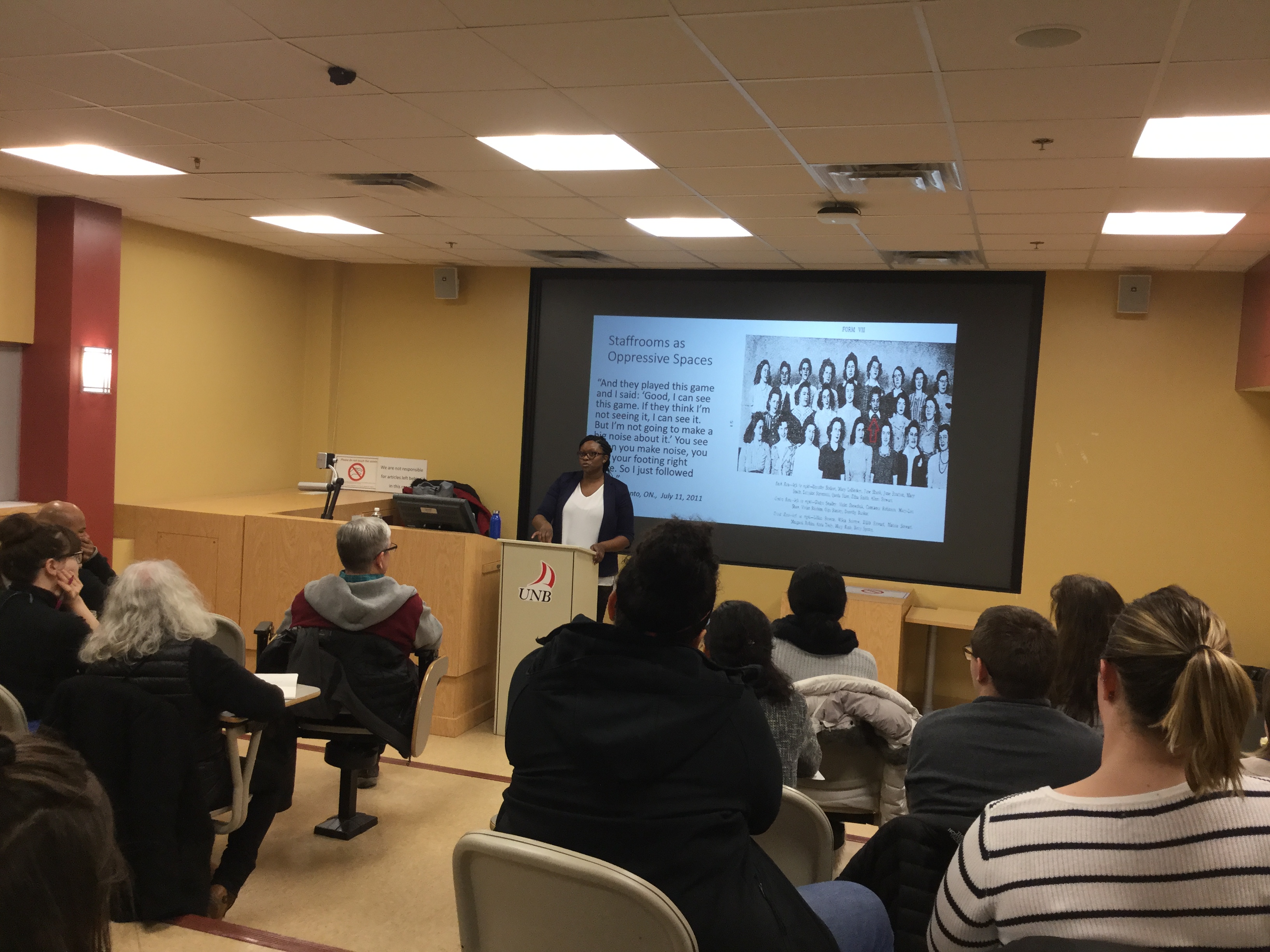
Dr. Funké Aladejebi speaking at the University of New Brunswick in Fredericton on Jan. 15, 2019. Photo by Sophie M. Lavoie.

0
SHARES
0
VIEWS

Education was “a tool for social transformation and community survival” for many women educators of colour.

An enthusiastic group of one hundred people attended a lecture by Dr. Funké Aladejebi at the University of New Brunswick on Jan. 15, 2019.  Aladejebi is a recent hire in the university’s Gender and Women’s Studies and History. She specializes in African Canadian History, especially in the field of education.

Aladejebi’s research is done within a decolonizing education framework, in order to “recognize the place of African descendent people on this land.” In Canada, “othering and anti-blackness” have been present despite a public discourse that promoted (and still encourages) equality and multiculturalism.

The hidden curriculum is defined as the unconscious and culturally based values that are brought into schools. These include social relationships, attitudes, beliefs, assumptions, all of which feed processes of exclusion of people of colour. This hidden curriculum implicitly streamed students of colour into vocational, technical and non-academic programs.

Aladejebi’s research stems from oral histories gleaned from women teachers of colour who indicated that “racial and gendered exclusion [were] part of this experience” in the education system.

Many of the women of colour teaching in these schools were Canadian-born women with a long experience in the Canadian school system. However, their experience mirrored the racism in Canadian society. Most of these women made “huge personal sacrifices” in these jobs as educators: family, partners, separated and/or disconnected from their community.

In the 1980s, equity quotas for women were put in place. However, according to Aladejebi’s research, “not all women benefitted from these quotas in the same way.” In her discussions with black educators, Aladejebi found that many school spaces were places of oppression.

For example, staffrooms were a place of exclusion, oppression and microagressions, as Aladejebi’s interview subjects remembered. For non-racialized teachers, these common spaces were “places of safety and comfort” but also areas for them to voice their discriminatory views about students and other teachers of colour. Some of Aladejebi’s interview subjects even noted that they were told not use the staffrooms to eat their lunch.

One room rural schools in black communities were considered the least oppressive spaces. Black communities were “a refuge where women could continue to do the work that they were doing.”

In view of the negative attitudes, some valiant teachers decided to “augment curriculum within their individual classrooms.” These educators saw “education as a tool for social transformation and community survival.” For many of the women, their new pedagogical approaches were linked to their investment in their community.

These women used what Aladejebi termed as “resistive pedagogies,” needed to dismantle the dominant system. In order to do this, all teachers must examine “ways [they] implicitly bring biases into classrooms” and change the narrative to create “spaces of safety in institutions where they found oppression.”

Educators of colour were also “burdened” with changing a context that was much larger than they could really handle. However, in Aladejebi’s research, “a growing female consciousness in the seventies and eighties” also occasionally offered “opportunities for black educators to forge relationships with their colleagues.”

Aladejebi’s findings have wide implications and parallels in New Brunswick. This is particularly true with regards to Indigenous students’ education and the Calls to Action from the Truth and Reconciliation Commission, many of which are being implemented at this moment. Other correspondences can be found in the treatment of people of colour, such as the recent immigrants from Syria, as was remarked by one audience member during the question and answer period.

Sophie M. Lavoie is a NB Media Co-op editorial board member.

Tags: black educatorseducationFunké AladejebisliderSophie M. Lavoie

Recommended

No Content Available

Site Links

  • Log in
  • Entries feed
  • Comments feed
  • WordPress.org
  • “I can’t believe I get to live in a place like this”: Deborah Carr
  • “Our rural roads are dangerous”: Cheryl Johnson
  • “Scarlet flowers in a messy garden:” Rick Roth
  • 2021 CUPE strike
  • About
  • Archives
  • Brian Beaton Annual Prize in Journalism for Justice / Le prix annuel de journalisme Brian Beaton pour la justice
  • Calendar
  • Comment soumettre votre article
  • Contact
  • Front Page
  • Garlic and optimism by Stephanie Coburn
  • google site verification – do not delete
  • Join the Co-op / Donate
  • Local Journalism Initiative
  • Markets and inter-generational goodness by Teri McMackin
  • Nuclear energy in New Brunswick
  • On hanging on and being hopeful: Deborah Carr
  • Our Team / Notre Équipe
  • Posts Page
  • Privacy policy
  • Share a Story
  • Subscribe/ S’abonner
  • The Brief / En Bref
  • The hills of Penobsquis by Beth Nixon
  • The NB debrief with Tobin Haley
  • Devenir membre / Faire un don
  • Donation Confirmation
  • Donation Failed
  • Donor Dashboard

© 2026 JNews - Premium WordPress news & magazine theme by Jegtheme.

No Result
View All Result
  • “I can’t believe I get to live in a place like this”: Deborah Carr
  • “Our rural roads are dangerous”: Cheryl Johnson
  • “Scarlet flowers in a messy garden:” Rick Roth
  • 2021 CUPE strike
  • About
    • History
    • Join us / Rejoignez-nous
  • Archives
  • Brian Beaton Annual Prize in Journalism for Justice / Le prix annuel de journalisme Brian Beaton pour la justice
  • Calendar
  • Comment soumettre votre article
  • Contact
  • Front Page
  • Garlic and optimism by Stephanie Coburn
  • google site verification – do not delete
  • Join the Co-op / Donate
  • Local Journalism Initiative
  • Markets and inter-generational goodness by Teri McMackin
  • Nuclear energy in New Brunswick
  • On hanging on and being hopeful: Deborah Carr
  • Our Team / Notre Équipe
  • Posts Page
  • Privacy policy
  • Share a Story
  • Subscribe/ S’abonner
  • The Brief / En Bref
  • The hills of Penobsquis by Beth Nixon
  • The NB debrief with Tobin Haley
  • Devenir membre / Faire un don
  • Donation Confirmation
  • Donation Failed
  • Donor Dashboard

© 2026 JNews - Premium WordPress news & magazine theme by Jegtheme.

X
Did you like this article? Support the NB Media Co-op! Vous avez aimé cet article ? Soutenez la Coop Média NB !
Join/Donate