• “I can’t believe I get to live in a place like this”: Deborah Carr
  • “Our rural roads are dangerous”: Cheryl Johnson
  • “Scarlet flowers in a messy garden:” Rick Roth
  • 2021 CUPE strike
  • About
    • History
    • Join us / Rejoignez-nous
  • Archives
  • Brian Beaton Annual Prize in Journalism for Justice / Le prix annuel de journalisme Brian Beaton pour la justice
  • Calendar
  • Comment soumettre votre article
  • Contact
  • Front Page
  • Garlic and optimism by Stephanie Coburn
  • google site verification – do not delete
  • Join the Co-op / Donate
  • Local Journalism Initiative
  • Markets and inter-generational goodness by Teri McMackin
  • Nuclear energy in New Brunswick
  • On hanging on and being hopeful: Deborah Carr
  • Our Team / Notre Équipe
  • Posts Page
  • Privacy policy
  • Share a Story
  • Subscribe/ S’abonner
  • The Brief / En Bref
  • The hills of Penobsquis by Beth Nixon
  • The NB debrief with Tobin Haley
  • Devenir membre / Faire un don
  • Donation Confirmation
  • Donation Failed
  • Donor Dashboard
NB Media Co-op
No Result
View All Result
No Result
View All Result
NB Media Co-op
No Result
View All Result
Home Environment

Mi’kmaq activist calls for broad alliance using treaty rights to fight climate change

by Bruce Wark
December 11, 2021
in Environment, Indigenous, New Brunswick, Rural
0

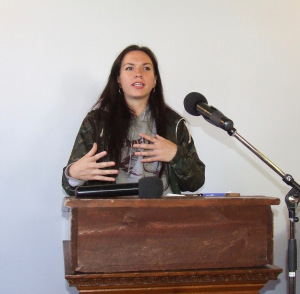
Rebecca Moore speaking on how indigenous treaties can be used to fight climate change on Oct. 1 in Pugwash. Photo by Bruce Wark.

0
SHARES
0
VIEWS

A Mi’kmaq woman from the Pictou Landing First Nation says indigenous treaties can be a key tool in the fight against climate change.

Rebecca Moore was speaking on Oct. 1 at the conclusion of a thinkers conference on climate change in Pugwash, Nova Scotia.

The last day of the conference coincided with the October 1st anniversary of the 1752 Treaty of Friendship and Peace between the Mi’kmaq and the British Crown.

Moore, who is a community energy campaigner with the Ecology Action Centre in Halifax, said the treaty can form the basis for an environmental alliance between indigenous and settler communities.

“We can use the position that indigenous people have, the inherent rights to the land and to protecting the land,” Moore said, “to keep it safe and to protect it.”

She added, for example, that treaty rights can be used to challenge companies that damage the environment when they extract resources from Crown lands. Treaty rights can also be used, she said, to reclaim Crown lands for better uses, but the key is to use these rights as part of a broader alliance.

“I can go and assert my rights as much as I want, but without support from allies it’s probably too difficult to create the significant change that we would need.”

Drawdown project

Leon de Vreede

Moore was one of 22 participants at the three-day conference on climate change. Another was Leon de Vreede, who has worked for nearly 10-years as a sustainability planner for the Town of Bridgewater, Nova Scotia. At yesterday’s closing session, he echoed Rebecca Moore’s message about forming environmental alliances as part of our “last chance” to avert the threat posed by climate change.“The synergy that’s possible by having our mainstream Canadian society working hand-in-hand with our First Nations partners, the synergy that can arise from that, is really, really incredible,” de Vreede said.

He referred to the Drawdown Project, a global plan that outlines 100 solutions designed to reverse the buildup of atmospheric greenhouse gases within 30 years. (The Drawdown Project and the book based on it served as a framework for the Pugwash conference.)

“I also think that doing the Drawdown work may also be our last chance to get some of our social justice issues right in our communities,” de Vreede said.

“We could actually liberate a whole bunch of resources and a whole bunch of energy, that if we design it right, can bring people to a more equal footing in our society,” he added.

de Vreede said Bridgewater has undertaken a wide range of projects designed to curb greenhouse gas emissions including a home energy program in which the town provides money for upgrades that homeowners can repay over a long period at low interest rates.

60th anniversary

John and Cathy Eaton, grandson and granddaughter of Cyrus Eaton

The conference on climate change was held to coincide with the 60th anniversary of the first conference at the Pugwash Thinkers Lodge. It was the brainchild of Cyrus Eaton, a wealthy American businessman who was born near Pugwash. The 22 participants in 1957 discussed the threat of nuclear weapons to human survival.

Cathy Eaton, granddaughter of Cyrus Eaton who attended this year’s conference along with her brother John, said climate change represents another such threat. She added that the focus on community solutions at this conference made Pugwash an especially appropriate place to hold it.

“Back in 1957, the community of Pugwash made a huge difference in welcoming the people, inspiring them to trust each other and to have conversations,” she said.

“I think the whole idea of this conference is that you’re looking at the communities from the Maritimes to come together and make change and have conversations and know that…each community can make a difference and that there’s an awful lot to be done. If it isn’t done, it can spell the end of the world as we know it.”

This story was first published by The New Wark Times. 

Tags: Bruce WarkClimate ChangeIndigenousMi'kmaqnuclearPugwashslidertreaties

Recommended

No Content Available

Site Links

  • Log in
  • Entries feed
  • Comments feed
  • WordPress.org
  • “I can’t believe I get to live in a place like this”: Deborah Carr
  • “Our rural roads are dangerous”: Cheryl Johnson
  • “Scarlet flowers in a messy garden:” Rick Roth
  • 2021 CUPE strike
  • About
  • Archives
  • Brian Beaton Annual Prize in Journalism for Justice / Le prix annuel de journalisme Brian Beaton pour la justice
  • Calendar
  • Comment soumettre votre article
  • Contact
  • Front Page
  • Garlic and optimism by Stephanie Coburn
  • google site verification – do not delete
  • Join the Co-op / Donate
  • Local Journalism Initiative
  • Markets and inter-generational goodness by Teri McMackin
  • Nuclear energy in New Brunswick
  • On hanging on and being hopeful: Deborah Carr
  • Our Team / Notre Équipe
  • Posts Page
  • Privacy policy
  • Share a Story
  • Subscribe/ S’abonner
  • The Brief / En Bref
  • The hills of Penobsquis by Beth Nixon
  • The NB debrief with Tobin Haley
  • Devenir membre / Faire un don
  • Donation Confirmation
  • Donation Failed
  • Donor Dashboard

© 2026 JNews - Premium WordPress news & magazine theme by Jegtheme.

No Result
View All Result
  • “I can’t believe I get to live in a place like this”: Deborah Carr
  • “Our rural roads are dangerous”: Cheryl Johnson
  • “Scarlet flowers in a messy garden:” Rick Roth
  • 2021 CUPE strike
  • About
    • History
    • Join us / Rejoignez-nous
  • Archives
  • Brian Beaton Annual Prize in Journalism for Justice / Le prix annuel de journalisme Brian Beaton pour la justice
  • Calendar
  • Comment soumettre votre article
  • Contact
  • Front Page
  • Garlic and optimism by Stephanie Coburn
  • google site verification – do not delete
  • Join the Co-op / Donate
  • Local Journalism Initiative
  • Markets and inter-generational goodness by Teri McMackin
  • Nuclear energy in New Brunswick
  • On hanging on and being hopeful: Deborah Carr
  • Our Team / Notre Équipe
  • Posts Page
  • Privacy policy
  • Share a Story
  • Subscribe/ S’abonner
  • The Brief / En Bref
  • The hills of Penobsquis by Beth Nixon
  • The NB debrief with Tobin Haley
  • Devenir membre / Faire un don
  • Donation Confirmation
  • Donation Failed
  • Donor Dashboard

© 2026 JNews - Premium WordPress news & magazine theme by Jegtheme.

X
Did you like this article? Support the NB Media Co-op! Vous avez aimé cet article ? Soutenez la Coop Média NB !
Join/Donate