• “I can’t believe I get to live in a place like this”: Deborah Carr
  • “Our rural roads are dangerous”: Cheryl Johnson
  • “Scarlet flowers in a messy garden:” Rick Roth
  • 2021 CUPE strike
  • About
    • History
    • Join us / Rejoignez-nous
  • Archives
  • Brian Beaton Annual Prize in Journalism for Justice / Le prix annuel de journalisme Brian Beaton pour la justice
  • Calendar
  • Comment soumettre votre article
  • Contact
  • Front Page
  • Garlic and optimism by Stephanie Coburn
  • google site verification – do not delete
  • Join the Co-op / Donate
  • Local Journalism Initiative
  • Markets and inter-generational goodness by Teri McMackin
  • Nuclear energy in New Brunswick
  • On hanging on and being hopeful: Deborah Carr
  • Our Team / Notre Équipe
  • Posts Page
  • Privacy policy
  • Share a Story
  • Subscribe/ S’abonner
  • The Brief / En Bref
  • The hills of Penobsquis by Beth Nixon
  • The NB debrief with Tobin Haley
  • Devenir membre / Faire un don
  • Donation Confirmation
  • Donation Failed
  • Donor Dashboard
NB Media Co-op
No Result
View All Result
No Result
View All Result
NB Media Co-op
No Result
View All Result
Home Culture

Lives lived: Saint John’s working-class heroes

by David Frank
February 21, 2020
in Culture, Labour, New Brunswick
0
Lives lived: Saint John’s working-class heroes

Author George Vair examines a new exhibit at the Frank and Ella Hatheway Labour Exhibit Centre. Photo by David Frank.

0
SHARES
0
VIEWS

Almost all of them were born before the end of the First World War, several as early as the 1870s and 1880s. Their formal education was limited, and they entered the workforce well before they were out of their teens.

None of them started out to become leaders or win a place in history, but here they are – more than a dozen of the often anonymous local heroes who worked long and hard for the social reforms and citizenship rights that are now considered part of the Canadian way of life.

Their names? Percy Clark. Bill Craig. Frank Crilley. Fred Hodges. Angus MacLeod. Lofty MacMillan. George Melvin. Jimmy Orr. John Simonds. Art Skaling. Harold Stafford. James Sugrue. James Tighe. James Whitebone.

Most of these names are not well-known in Saint John today, but a new booklet published by the Frank and Ella Hatheway Labour Exhibit Centre makes it possible to learn about some of the people who earned public respect for their part in the long struggle to improve conditions and raise standards for working people.

Whatever their background and wherever they were employed, they came to prominence because fellow workers pushed them forward to take on leadership responsibilities. They were often chosen as local union officers, and many went on to serve on the labour council and at the provincial federation of labour.

Some later worked at the national and international levels. Some were elected to represent labour on common council. One even became the province’s minister of labour. Meanwhile, as their stories also show, they were active in many other ways in the social movements and institutions that make for a strong community.
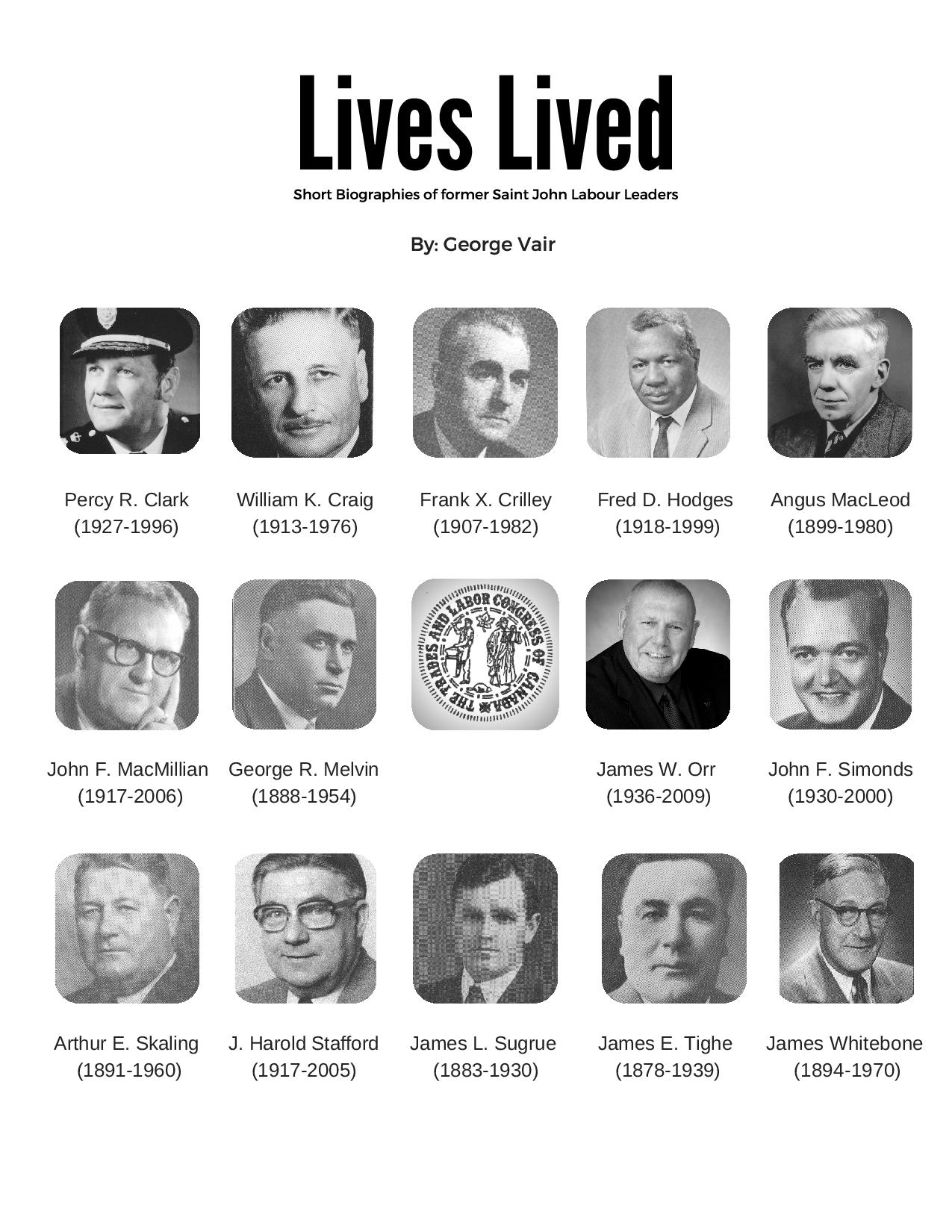
Lives Lived: a new booklet features short biographies of fourteen Saint John labour activists.

It is notable that all of them are men – not surprising given the dominant male breadwinner ideology of their time. And, although a number of them were immigrants to Saint John, almost all of them share the dominant anglo-celtic background of the city. Today’s working class is more diverse, most notably in the much more equal numbers of women and men in the workforce.

Taken together, these stories demonstrate the energy, confidence and intelligence that have made Saint John one of Canada’s most resilient working-class communities. It is true that we still have great inequalities in our society and that our own times present continuing challenges. But there is much to learn from the achievements of the people presented here, especially for those who wish to defend and extend the achievements of the past.

The man behind the booklet is George Vair, a former president of the Saint John and District Labour Council, who has made it his mission to preserve and share local labour history. For several years now, he has been gathering these “Lives” and posting them on the website of the Hatheway Centre.

Now they have been compiled in a small booklet available from the Hatheway Centre, which itself continues to flourish at the end of its first ten years of operation. One of the bonuses of this new booklet is that it helps to draw attention to the Centre. After ten years of operation, their impressive display of artefacts, documents and photographs continues to grow and attract attention.

In the past month alone, the Centre has seen visitors from as far away as Vancouver, Chile and Scotland. Like them, you may want to make the pleasant visit to Rockwood Park and pause for a few moments before the portraits of Frank and Ella Hatheway, two more of the city’s early social reformers, whose lives also helped inspire one of the city’s hidden heritage treasures.

Lives Lived is available at the Frank and Ella Hatheway Labour Exhibit Centre. Admission is free, and the Centre is open for visitors all summer Monday through Friday.

David Frank is the author of Provincial Solidarities: A History of the New Brunswick Federation of Labour (Edmonton: Athabasca University Press, 2013). This article is based on his preface to George Vair’s Lives Lived: Short Biographies of Former Saint John Labour Leaders.

Tags: David FrankGeorge VairlabourNew BrunswickSaint Johnsliderunionworking class

Recommended

No Content Available

Site Links

  • Log in
  • Entries feed
  • Comments feed
  • WordPress.org
  • “I can’t believe I get to live in a place like this”: Deborah Carr
  • “Our rural roads are dangerous”: Cheryl Johnson
  • “Scarlet flowers in a messy garden:” Rick Roth
  • 2021 CUPE strike
  • About
  • Archives
  • Brian Beaton Annual Prize in Journalism for Justice / Le prix annuel de journalisme Brian Beaton pour la justice
  • Calendar
  • Comment soumettre votre article
  • Contact
  • Front Page
  • Garlic and optimism by Stephanie Coburn
  • google site verification – do not delete
  • Join the Co-op / Donate
  • Local Journalism Initiative
  • Markets and inter-generational goodness by Teri McMackin
  • Nuclear energy in New Brunswick
  • On hanging on and being hopeful: Deborah Carr
  • Our Team / Notre Équipe
  • Posts Page
  • Privacy policy
  • Share a Story
  • Subscribe/ S’abonner
  • The Brief / En Bref
  • The hills of Penobsquis by Beth Nixon
  • The NB debrief with Tobin Haley
  • Devenir membre / Faire un don
  • Donation Confirmation
  • Donation Failed
  • Donor Dashboard

© 2026 JNews - Premium WordPress news & magazine theme by Jegtheme.

No Result
View All Result
  • “I can’t believe I get to live in a place like this”: Deborah Carr
  • “Our rural roads are dangerous”: Cheryl Johnson
  • “Scarlet flowers in a messy garden:” Rick Roth
  • 2021 CUPE strike
  • About
    • History
    • Join us / Rejoignez-nous
  • Archives
  • Brian Beaton Annual Prize in Journalism for Justice / Le prix annuel de journalisme Brian Beaton pour la justice
  • Calendar
  • Comment soumettre votre article
  • Contact
  • Front Page
  • Garlic and optimism by Stephanie Coburn
  • google site verification – do not delete
  • Join the Co-op / Donate
  • Local Journalism Initiative
  • Markets and inter-generational goodness by Teri McMackin
  • Nuclear energy in New Brunswick
  • On hanging on and being hopeful: Deborah Carr
  • Our Team / Notre Équipe
  • Posts Page
  • Privacy policy
  • Share a Story
  • Subscribe/ S’abonner
  • The Brief / En Bref
  • The hills of Penobsquis by Beth Nixon
  • The NB debrief with Tobin Haley
  • Devenir membre / Faire un don
  • Donation Confirmation
  • Donation Failed
  • Donor Dashboard

© 2026 JNews - Premium WordPress news & magazine theme by Jegtheme.

X
Did you like this article? Support the NB Media Co-op! Vous avez aimé cet article ? Soutenez la Coop Média NB !
Join/Donate