• “I can’t believe I get to live in a place like this”: Deborah Carr
  • “Our rural roads are dangerous”: Cheryl Johnson
  • “Scarlet flowers in a messy garden:” Rick Roth
  • 2021 CUPE strike
  • About
    • History
    • Join us / Rejoignez-nous
  • Archives
  • Brian Beaton Annual Prize in Journalism for Justice / Le prix annuel de journalisme Brian Beaton pour la justice
  • Calendar
  • Comment soumettre votre article
  • Contact
  • Front Page
  • Garlic and optimism by Stephanie Coburn
  • google site verification – do not delete
  • Join the Co-op / Donate
  • Local Journalism Initiative
  • Markets and inter-generational goodness by Teri McMackin
  • Nuclear energy in New Brunswick
  • On hanging on and being hopeful: Deborah Carr
  • Our Team / Notre Équipe
  • Posts Page
  • Privacy policy
  • Share a Story
  • Subscribe/ S’abonner
  • The Brief / En Bref
  • The hills of Penobsquis by Beth Nixon
  • The NB debrief with Tobin Haley
  • Devenir membre / Faire un don
  • Donation Confirmation
  • Donation Failed
  • Donor Dashboard
NB Media Co-op
No Result
View All Result
No Result
View All Result
NB Media Co-op
No Result
View All Result
Home Canada

“Every single tomato has a story:” Film captures shattered dreams of migrant workers in Canada

by Tracy Glynn
April 30, 2020
in Canada, Culture, Immigration, Labour, New Brunswick
0
“Every single tomato has a story:” Film captures shattered dreams of migrant workers in Canada

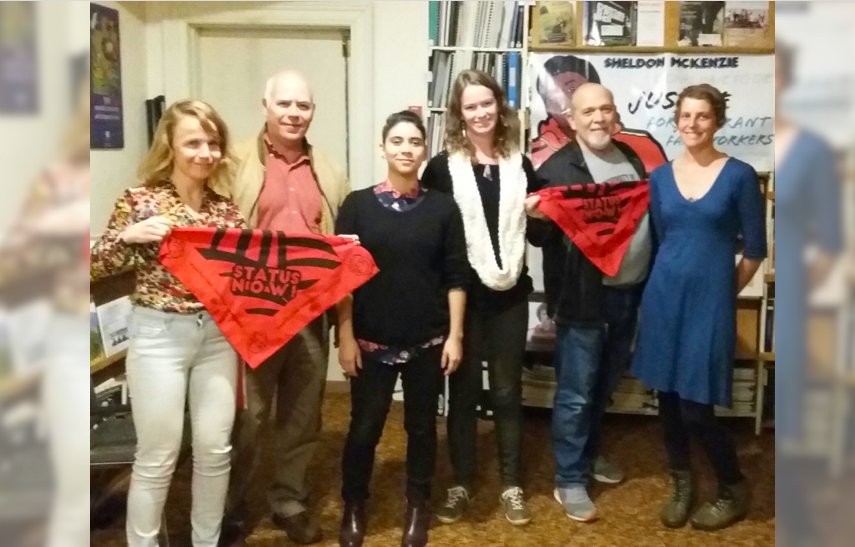
A crowd gathered for the Fredericton premiere of Migrant Dreams on Oct. 21. PIctured left-to-right: Tracy Glynn, organizer with No One Is Illegal-Fredericton, David Coon, MLA for Fredericton South, Tzaznà Miranda, organizer with Justice for Migrant Workers-Ontario, Amanda Wildeman, executive director of the National Farmers Union in NB, Ernie Caissie, President of the Fredericton District Labour Council and Josie Baker with the Cooper Institute in PEI. Photo by Sophie M. Lavoie.

0
SHARES
0
VIEWS

Fredericton – A film documenting systemic oppression and exploitation of migrant workers by recruiters and the government in small-town Ontario premiered to Maritime audiences in late October. Migrant Dreams, Min Sook Lee’s latest documentary on migrant workers in Canada, follows women and trans migrant workers from Indonesia and other countries who are struggling to make enough money to send back home to their families.

“Every single tomato has a story… it’s a story of transnational families and shattered dreams,” said Evelyn Encalada, an organizer with Justice for Migrant Workers in Ontario, who is featured in the film.

“It is important to honour the workers’ resistance,” said Josie Baker from the Cooper Institute, a PEI social justice organization. Baker accompanied Tzaznà Miranda with Justice for Migrant Workers – Ontario on a tour to five communities in the Maritimes, including Shediac, NB, and O’Leary, PEI, where migrants from Jamaica, the Philippines and other countries work at fish plants.

Miranda spoke of the successful Harvesting Freedom Campaign, which recently completed a pilgrimage to Ottawa with migrant farm workers and their allies. The campaign, marking the 50th anniversary of Canada’s agricultural migrant worker program, called for permanent residency status for migrant workers. “There is nothing temporary about a program that has been bringing workers here for 50 years,” said Miranda.

Today, about half a million migrant workers with temporary work permits enter Canada every year. The number of migrant workers entering Canada has surpassed the number of immigrants entering the country every year since 2006.

A federal review of the Temporary Foreign Worker Program was recently tabled in Parliament. The review contains 21 recommendations for policy changes, though the timeline and nature of the coming changes are still unclear, according to migrant justice groups. Meanwhile, a number of workers from the Philippines employed at fish plants in PEI are waiting to hear if their six-month work contracts will be extended or if they will be forced to go back home.

Justice for Migrant Workers has also been trying to get the government to make changes to the program’s rules to give workers more rights. They say workers are treated as disposable and injured workers are often cut off from health care coverage.

A banner that read, “Sheldon McKenzie Didn’t Have to Die,” was put on the wall at the film venue in Fredericton. Miranda said it is important to memorialize workers like McKenzie who have died while working in Canada.

McKenzie, 39, suffered an injury at work on a farm in Leamington, Ontario, in early 2015 that left him on life support. His family tried to stop his deportation so he could access health care. He lost his work visa and health care coverage when he was no longer able to work. McKenzie had been coming back and forth from Jamaica to Canada for twelve years, spending months in Canada doing manual labour on farms, sending the money he made to his wife and two daughters in Jamaica. McKenzie died before his advocates were able to get him a humanitarian visa to extend his stay so he could access health care.

“Nobody should have to die for a pepper, nobody should have to die for a tomato,” Miranda told the audience gathered at the Fredericton film screening. Ernie Caissie, president of the Fredericton District Labour Council, agreed, “Nobody should have to die for a job.”

Tracy Glynn is a member of No One Is Illegal Fredericton.

Tags: David Coonmigrant justicemigrant workermigrant workersNo One Is IllegalsliderTracy Glynn

Recommended

No Content Available

Site Links

  • Log in
  • Entries feed
  • Comments feed
  • WordPress.org
  • “I can’t believe I get to live in a place like this”: Deborah Carr
  • “Our rural roads are dangerous”: Cheryl Johnson
  • “Scarlet flowers in a messy garden:” Rick Roth
  • 2021 CUPE strike
  • About
  • Archives
  • Brian Beaton Annual Prize in Journalism for Justice / Le prix annuel de journalisme Brian Beaton pour la justice
  • Calendar
  • Comment soumettre votre article
  • Contact
  • Front Page
  • Garlic and optimism by Stephanie Coburn
  • google site verification – do not delete
  • Join the Co-op / Donate
  • Local Journalism Initiative
  • Markets and inter-generational goodness by Teri McMackin
  • Nuclear energy in New Brunswick
  • On hanging on and being hopeful: Deborah Carr
  • Our Team / Notre Équipe
  • Posts Page
  • Privacy policy
  • Share a Story
  • Subscribe/ S’abonner
  • The Brief / En Bref
  • The hills of Penobsquis by Beth Nixon
  • The NB debrief with Tobin Haley
  • Devenir membre / Faire un don
  • Donation Confirmation
  • Donation Failed
  • Donor Dashboard

© 2026 JNews - Premium WordPress news & magazine theme by Jegtheme.

No Result
View All Result
  • “I can’t believe I get to live in a place like this”: Deborah Carr
  • “Our rural roads are dangerous”: Cheryl Johnson
  • “Scarlet flowers in a messy garden:” Rick Roth
  • 2021 CUPE strike
  • About
    • History
    • Join us / Rejoignez-nous
  • Archives
  • Brian Beaton Annual Prize in Journalism for Justice / Le prix annuel de journalisme Brian Beaton pour la justice
  • Calendar
  • Comment soumettre votre article
  • Contact
  • Front Page
  • Garlic and optimism by Stephanie Coburn
  • google site verification – do not delete
  • Join the Co-op / Donate
  • Local Journalism Initiative
  • Markets and inter-generational goodness by Teri McMackin
  • Nuclear energy in New Brunswick
  • On hanging on and being hopeful: Deborah Carr
  • Our Team / Notre Équipe
  • Posts Page
  • Privacy policy
  • Share a Story
  • Subscribe/ S’abonner
  • The Brief / En Bref
  • The hills of Penobsquis by Beth Nixon
  • The NB debrief with Tobin Haley
  • Devenir membre / Faire un don
  • Donation Confirmation
  • Donation Failed
  • Donor Dashboard

© 2026 JNews - Premium WordPress news & magazine theme by Jegtheme.

X
Did you like this article? Support the NB Media Co-op! Vous avez aimé cet article ? Soutenez la Coop Média NB !
Join/Donate