

“Home is a notion that only nations of the homeless fully appreciate and only the uprooted comprehend.” – Wallace Stegner, Angle of Repose, Doubleday, 1971.
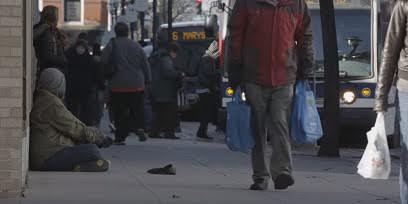
You see them on the street; maybe in the park. You might drop a coin or two into a paper cup or a hat. You might say “Hi.” You might pretend they are not there. You might blame them for their circumstance. You might resent them. Maybe you care; maybe you don’t. You may even believe that you are better than they are. After all, you have a home. Those few homeless that you see are the obvious tip of an unacceptable iceberg.
“Homelessness is far more pervasive in our community than we would like to imagine: it is often hidden and unrecognized. Homelessness not only comes at a great moral cost to a society but also great financial cost as well. The Canadian Observatory on Homelessness asks, “can we save money but doing the right thing” and learned that the answer is yes,” says Faith McFarland, Coordinator, Community Action Group on Homelessness in Fredericton.
Homelessness is expensive. That one homeless person that you see? If we provided that one person with housing and the supports needed to maintain it we start saving money, lots of money. That is why we need to adopt the principles and philosophy of Housing First.
The nation-wide At Home/Chez Soi study discovered an investment of $10.00 in Housing First services saved $21.72 in emergency and standard support services. In Fredericton, one Housing First project with twelve participants saw a positive cost differential of over $200,000 in its inaugural year over the standard emergency treatment of shelters, transition houses, police interaction, and hospital and institutional measures. The standard measures of treatment are an expense born by both taxpayers and charitable organizations without creating the cost benefits that result from the permanent housing that accrues from the Housing First approach. Housing First research from across the country regularly shows savings of $50-100,000 per person per year.
The numbers of homeless and the costs of keeping people homeless are disturbing. A 2016 study conducted in Fredericton as part of the 20,000 Homes Campaign found 50 absolutely homeless people in our city in just one night. The Moncton study found 77; St. John 60; Bathurst 12. Absolute homeless refers to people who are unsheltered/sleeping outdoors or emergency sheltered, in shelter system.
Those are the 199 people the study on one night in late February 2016, but they are not the only people who face homelessness. The 2012 Homeless Hub’s Community Profile on Fredericton estimated that there were 1300 New Brunswick citizens living in hidden homelessness and that over 9500 households were at risk of homelessness, but there is reason to hope. In fact, there is a means to ending our current homelessness and to preventing future homelessness.
Working with the principles of Housing First, New Brunswick can end chronic/episodic homelessness. We can ensure that those facing homelessness in the future will not need to access costly emergency shelters and services for more than ten days. We can ensure that the homeless receive the services needed to keep them off the street, give the hidden homeless safe and affordable shelter, and reduce the number of households at risk of losing their homes.
Housing First has a proven success record in both Canada and the United States and, for our purposes, has shown to be a success here in New Brunswick. This community-based consumer-driven success has benefits that are not only measured in human savings but in economic costs.
Once a person is identified, the implementation of Housing First begins with quickly providing suitable, affordable housing without the extant restrictions (drug-free, sober, employed) and then providing any services required to keep the participants housed. Housing First works to locate suitable housing, and works with the landlord to build mutually beneficial relationships between the participant and the landlord. The participant must comply with a standard Landlord/Tenant Agreement and also agrees to regular visits by service providers. Finally, the participants are treated as individuals and receive the targeted services and supports necessary to maintain their housing on a permanent basis.
Housing First recognizes that existing social services are more effective in stabilizing individuals and families when they are in their own homes. The homeless cannot recover from addictions, chronic health physical issues or mental health challenges while living on the street.
In Fredericton, the John Howard Society’s Main Street Project reports that, for its twelve residents, their Housing First placements showed a cost difference of $202,975.00 in its inaugural year. This amounts to a tax/charitable donation savings of over $16,000 for each individual. Some of the savings were shown through:
An 89% reduction in emergency department saving $3,000
A 43% reduction in justice system contacts saving $87,000.
An 84% reduction in hospitalization saving $119,000
Housing First’s foundation is built on a few Core Principles and Canada’s 20,000 Homes Campaign further advises that we know every homeless person by name; that we use data to track an individual’s progress; and that we create coordinated, systematic care for the homeless. Housing First allows communities to limit the amount of time anyone is homeless and works to prevent future homelessness. The Housing First philosophy aims to end homelessness not simply manage (mismanage?) homelessness.
There is a significant and comprehensive legal reason for putting an end to homelessness confirmed by Canada’s signature on the United Nation’s 1966 International Covenant on Economic, Social and Cultural Rights. (Signed 19 May 1976). It is imperative that we assist our citizens who, through no fault of their own, have become homeless. It also makes no economic sense for us to leave people homeless.
The cost of homelessness is too high.
Norm Skelton is a volunteer with Fredericton’s Community Action Group on Homelessness and an At-Large Member of Canada Without Poverty’s Board of Directors.