

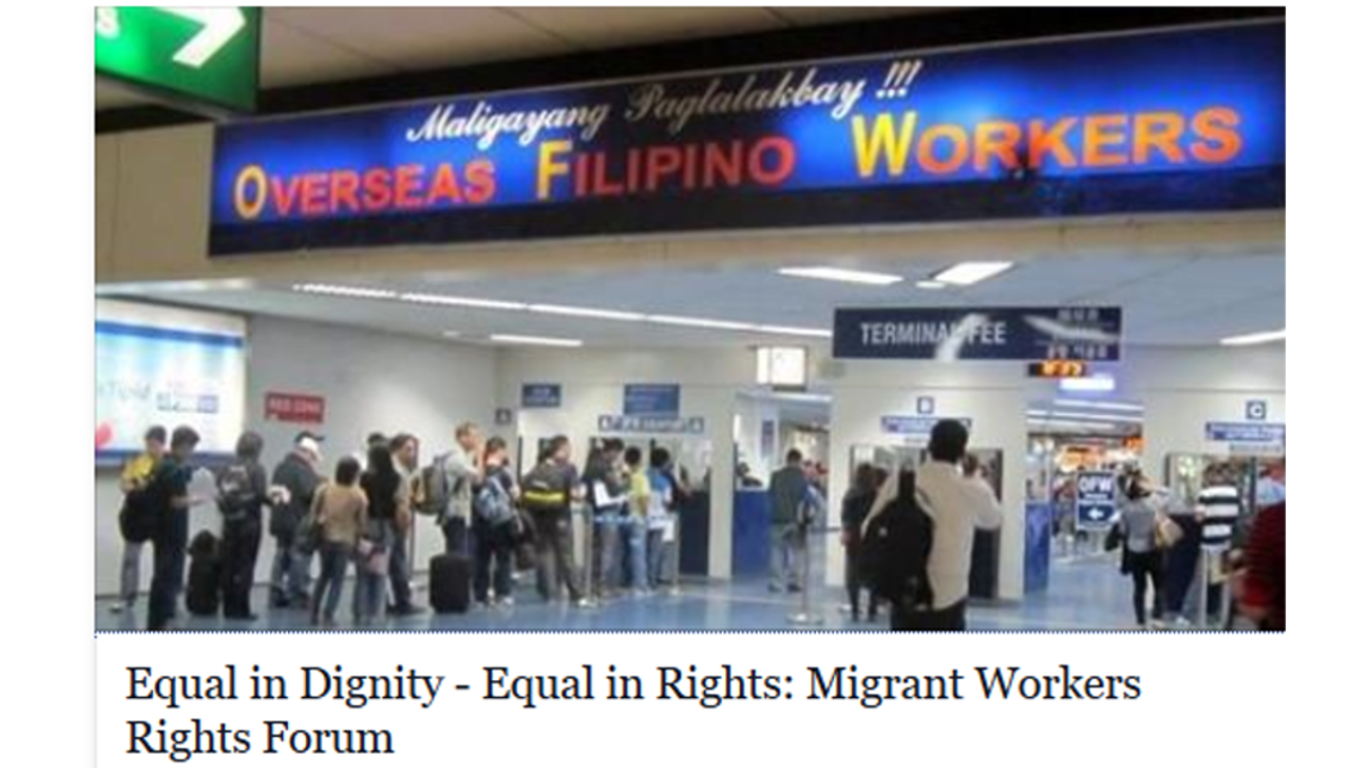
Community, faith and labour organizations have partnered on an event in Fredericton “to build relationships of solidarity with workers who are coming to Canada from all over the world”. The organizers are faith based social justice organization KAIROS Canada, Filipino migrant worker advocacy group MIGRANTE, CUPE NB, and the Canadian Labour Congress. The event is titled, Equal in Dignity – Equal in Rights: Migrant Workers Forum”, and will be held on Saturday, February 13 at the Fredericton Inn and Convention Centre from 9AM until 4PM. There is no cost.
The forum is expected to bring together over 75 migrant workers, domestic workers, civil society groups, labour organizations, students and others interested in working together to advance the rights of migrant workers in the Maritimes and across the country.
Presenters include Jesson Reyes of Migrante Canada; Josie Baker of the Cooper Institute; Serge Landry, National Representative of the Canadian Labour Congress Atlantic Region; and Alma Damasco, a worker from the Philippines.
Connie Sorio is KAIROS’ Migrant Justice and Partnerships Coordinator and a lead oganizer of the event. “Our Goal is to create a clear pathway to permanent residency, open work permits and access to community support services,” says Sorio.
A wide range of industries within the Maritimes rely heavily on migrant workers. They range from retail stores, to food services such as Tim Hortons, to fish plants on Deer Island and farms in Woodstock.
Sorio notes that one particular agricultural operation in Woodstock employs up to 500 migrant workers in any given year.
In 2012, the latest year for which statistics are available, 8,363 migrant workers were reported in the Maritimes. 2,880 of those were in New Brunswick, with over half working outside of the three major urban centres (Moncton, Saint John and Fredericton). According to a Parliamentary Budget Office report, between 2002-2012 New Brunswick and Prince Edward Island both outpaced Alberta in terms of increasing Temporary Foreign Workers as a percentage of the labour force.
While migrant workers are increasingly becoming a part of our communities through the work they do and lives they live while here, they are not permitted to become permanent residents under the Temporary Foreign Workers program that brings them to Canada.
“The work permit and visa are tied to the employer and their job,” says Sorio. If they lose their jobs, “their status in Canada ceases to exist and means they can be sent home,” explains Sorio.
Their only recourse after termination is to quickly find another job. The process can take up to four months. The problem arises, according to Sorio, with the fact that you are only given 90 days to find alternative employment before being sent home. The problem of finding alternative employment is further complicated by recent changes to the program.
“In 2015 the (Government of Canada) decreased the allowed percentage of migrant workers an employer can have on staff to 20% and in 2016 they decreased it to 10%,” says Sorio.
This means that the opportunity to find replacement work, let alone work at all, has been diminishing in recent years. Sorio notes that many migrant workers have been working in Canada for decades. Although they have contributed so much to the Canadian economy, they are seeing their chances of staying in the country erode.
A further obstacle to migrant workers staying in Canada is the moratorium on hiring in the food service and retail industry. As Sorio states, “this hurts (migrant workers’) ability to find work once their position is terminated which, again, means they have to leave.”
Sorio has been meeting with migrant workers throughout the Maritimes and across the country. She has been hearing a common theme. Migrant workers want a sense of permanency and security within their jobs and their new communities. The answer is simple for her: give them permanent residency.
“We know that the jobs migrant workers are filling are not temporary,” says Sorio. “Why do we bring in people temporarily for jobs that are not?”
A full audio interview with Connie Sorio can be found on the From the Margins’ podcast