


This story was first published by the Halifax Media Co-op and the NB Media Co-op in October 2015.
KJIPUKTUK (Halifax) — The Halifax Media Co-op has acquired a series of internal communications from New Brunswick’s Department of Natural Resources that comprise literally hundreds of pages of emails related to newly-retired, whistle blowing, provincial deer biologist Rod Cumberland.
These communications are interesting for a variety of reasons, the least of which because they provide an insight into the manner that the bureaucratic machine in New Brunswick is very much linked into streamlining their publicly-presented message with their counterparts in industry, in particular with the efforts of J.D. Irving.
Whistle-blowing scientists take note: Never underestimate your ability to send your former employer into reaction mode, with all the bureaucratic and corporate cooperation and message massaging that that entails.
Upon his retirement in 2013, Cumberland, with early assistance from the Conservation Council of New Brunswick, began to publicly rail against the effects of New Brunswick’s glyphosate application program, whereby, since the 1970s, an estimated 12,000 – 15,000 hectares of Crown land are sprayed with the herbicide per year. Glyphosate mixtures are applied to Crown land in order to eliminate hardwood tree species and select for softwoods, which are then largely used for pulp. Readers may be more familiar with agricultural applications of glyphosate, where it is consistently among the most highly used herbicides in North America.
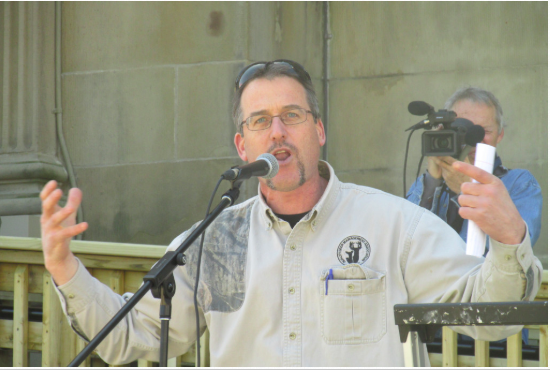
Cumberland’s wedge issue was that glyphosate spraying in New Brunswick is responsible for the province’s dwindling white-tailed deer population, as it destroys their food supplies. He has, however, continuously highlighted the scientifically-proven detrimental health impacts of exposure to glyphosate mixtures, and has gone so far as to liken the future health-related fall-out from glyphosate applications in New Brunswick to “this generation’s Agent Orange.”
Cumberland’s call for action against glyphosate, which followed in the footsteps of former tree planters such as Betty St. Pierre, gained a decent amount of traction across the province, especially as it was linked into the contentious issue of the province’s newly unveiled Crown Land Management Plan. In terms of direct action, a protest occurred near Rogersville, where a truck belonging to Forest Protection Ltd (one of the herbicide application companies) was blocked for several hours.
According to the documents acquired, the New Brunswick Department of Natural Resources (DNR), began email communication with the big lumber interests in the province, including India-owned AV Group, Norwegian-owned Fornebu Lumber, the publicly-trade Acadian Timber, and, of course, New Brunswick’s own J.D. Irving. Included in these initial emails were email addresses associated with the RCMP, as well as the provincial Department of Public Safety.
Cumberland, the province’s former top white-tail deer biologist, had gone rogue. Given his high standing within the bureaucratic machine, an action plan was needed to shut his message down.
Interestingly, these DNR-led emails discuss moving forward on the Cumberland-led issue of glyphosate spraying as an item of business for an already-existing “Risk Assessment Group” to address and analyze. This suggests the existence of a joint bureaucratic/corporate team, with at least some degree of RCMP participation, that analyzes and addresses issues of anti-corporate sentiment in New Brunswick as they flare up.
While not necessarily surprising in this day and age of rampant information sharing between government, industry and the state’s surveillance apparatus, it certainly does confirm the general suspicion in New Brunswick that certain key industrial players in the province have an arguably ‘too cozy’ relationship with the province’s bureaucracy.
An email dated January 27, 2014 also speaks to the merging of corporate interests and provincial governance. In this email, J.D. Irving’s in-house biologist John Gilbert, requests advanced knowledge of the DNR’s stance on Cumberland’s anti-glyphosate claims in order suitably lockstep his employer’s public reaction.
“I need to be aware of the department’s reply to craft our own response,” writes Gilbert.
The email chain also suggests that DNR actively sought out an expert who might counter Cumberland’s claims. An email from mid-February, 2014 suggests that the search is on for a “specialist or scientist to address Rod’s conjecture,” who could be from “another jurisdiction” if necessary.
The knowledge to take on Cumberland does not appear to exist, in-house, at the provincial DNR.
Interestingly, it is exactly days later that biologist and executive director at the Atlantic Canada Conservation Data Centre, R.A Lautenschlager, publicly surfaces as a would-be spoil to Cumberland’s anti-glyphosate claims. Lautenschlager has long been of the opinion that glyphosate applications do not negatively impact the abundance of deer food. The notion, however, that a February 25, CBC-assisted public debate between Cumberland and Lautenschlager was merely a happenstance affair of two divergent opinions is unlikely, given the timing of DNR’s scramble for a ‘science-approved’ counter voice to Cumberland.
More likely, Lautenschalger was tapped as DNR/industry’s champion and run up the flagpole for public consumption on Terry Seguin et al‘s ‘Information Morning’ Fredericton.
At the same time, speaking points “arising from the R. Cumberland” letter were being drafted internally for DNR spokespeople. Official answers for DNR staff were limited to the potential impact of glyphosate spraying on New Brunswick’s deer population, in particular their access to food.
DNR staff were given no official answer from the department on questions related to the potential human health impacts of glyphosate applications, on the well-understood impact that glyphosate spraying has already had on the structure of the Acadian forest, or on the possibility of alternate means of creating softwood tree plantations out of Crown land, such as high-employment saw spacing rather than herbicide application. Perhaps there was no bureaucratic appetite or ability to engage Cumberland on these topics. In any case, these were to remain uncomfortable elephants in the anti-glyphosate debate, points that, in their silence, New Brunswick DNR would appear to simply concede to Cumberland.
By March, 2015, internal emails show that Cumberland had requested a map of all known herbicide sprays from the DNR, dating back to the project’s inception. The request was initially shuffled off and bounced around between DNR bureaucrats. Cumberland’s assertion was that while glyphosate may only be applied to a very small percentage of Crown land per year (between 0.4% and 1% annually), over the course of decades this has added up to upwards of 20% application on all Crown lands.
By mid-April, 2015, after a DNR staffer finds Cumberland’s requested map “behind the desk” of a colleague, he asks “if it is ok to send it to Rod?”
This story was first published by the Halifax Media Co-op and shared with the NB Media Co-op. Miles Howe is a reporter with the Halifax Media Co-op.