

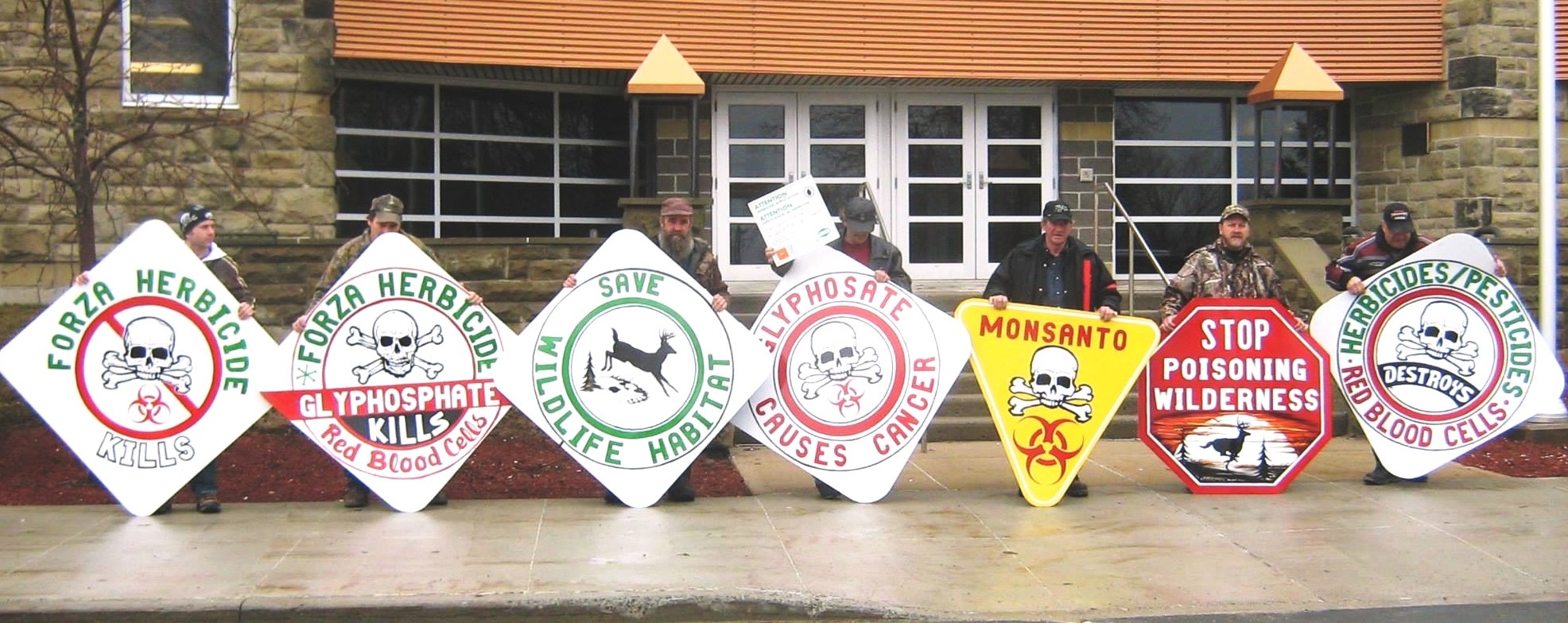
St. Ignace – Two Rogersville area men, Romeo Martin and Laurie Richard, have been sentenced to six months probation by a Miramichi court for their part in a protest last fall against the continued spraying of glyphosate herbicide on provincial forests. Charges of mischief against the pair were dropped during their April 30 court appearance, and protests against the use of glyphosate are increasing.
Opponents to glyphosate take little comfort in provincial government claims that New Brunswick’s forestry spraying program is safe. A March 2015 report by an agency of the World Health Organization (WHO) says the herbicide glyphosate is, in fact, a serious threat to public health, labeling it a “probably carcinogen.”
That report is fueling increased public opposition to and demonstrations against the use of glyphosate in New Brunswick. A demonstration dubbed the ‘March Against Monsanto’ and scheduled for Moncton City Hall on Saturday, May 23, at 1:00 p.m. was already being planned when news came that glyphosate had been linked to cancer in humans.
For its part, the provincial government is ignoring the cancer warning and continuing to insist that spraying glyphosates over vast tracts of the province is nothing to worry about.
The May 23 Moncton demonstration will highlight the March report from WHO’s International Agency for Research on Cancer (IARC) that declared glyphosate (which has been sprayed indiscriminately on forests and farm land across New Brunswick for years) damages human DNA and chromosomes. IARC, respected around the world for it’s expertise on cancer, also found convincing evidence that glyphosate causes cancer in animals, and linked the herbicide to non-Hodgkins lymphoma in people.
Glyphosate use has increased sharply since the development of genetically modified, or ‘GMO’d’ crops that are resistant to glyphosate. As well as agriculture and forestry, the herbicide is also used in urban settings, and has been detected in the air during spraying, as well as in water and in food.
Successive provincial governments in New Brunswick have denied or denigrated claims that glyphosate is highly dangerous for both people and animals. IARC’s research linking the herbicide to cancer and DNA and chromosomal damage have stripped government and corporate claims that the chemical is safe of any scientific credibility.
Forestry spraying has always been controversial in New Brunswick, and the IARC’s determination that glyphosate is dangerous to human and animal health vindicates what those protesting forest spraying programs have been saying for years. The discovery this spring of young moose dead in the forest has heightened the sense of urgency for New Brunswickers trying to stop the use of glyphosate on Crown land.

Glyphosates wiped out vegetation that is the food for moose, deer and other wildlife. Moose, deer, rabbits and other wildlife are primary sources of meat for many people in rural areas of New Brunswick. Any government or corporate program that kills these animals would also literally take food off poor people’s tables.
Woods workers, farmers and other New Brunswickers have already stated their intention to attend the May 23 Moncton demonstration. Leo Goguen is a woods worker in the Rogersville area who, speaking from experience, says the spraying of glyphosate on provincial forests “kills everything!”
The IARC’s damning report documenting glyphosate’s threat to human health, is also bolstering efforts to reduce or eliminate the use of highly toxic chemicals in connection with the production and marketing of both genetically modified, or ‘GMO’d,’ seeds and food crops.
The report may also provide the impetus for forestry workers, food producers, and people who simply want to eat healthy food to join hands in the common cause to stop the free and easy use of carcinogens in both food production and industrial applications.
Pamela Ross, one of the organizers for the Moncton demonstration, says the event is designed to help educate people about the dangers of genetically modified, or ‘GMO’d,’ foods and seeds. Ross chairs the Moncton Chapter of the Council of Canadians and says the Council wants “a ban on GMO food and seeds or, at the very least, a requirement that such foods be labeled” so that people know what they’re eating.
Theresa Richards is the Executive Director of the Atlantic Canada Organic Regional Network (ACORN). She says people can avoid the risks of GMO food by buying food that is certified organic, or growing their own garden from organic seed.
“Organic certification includes the soil, the seeds, and the plants grown from those seeds,” Richards says. “To be certified organic, a farmer must prove his seeds sources are supplying him with seed that is also certified organic.” That proof involves a requirement for independent, third-party audits to establish that seeds are organic, in addition to the requirement that his soil also be certified organic.
The United States Department of Agriculture (USDA) also requires organic seeds and soils before a product can be certified organic.
As well, people wanting to avoid eating GMO food can seek out and buy from local producers who don’t use chemical sprays of GMO seed. In New Brunswick, La Récolte de Chez Nous, an organization of independent food producers only sprays crops as a last resort.
Vida Cropas from St. Norbert in Kent County has also been helping to organize the March Against Monsanto. She describes herself as a “pesticide refugee” from Saskatchewan where agricultural crops have been heavily sprayed for years.
Cropas says her young daughter used to get seriously ill in the summer and only recover in the winter. Eventually her child was diagnosed with pesticide poisoning, and the family moved to New Brunswick.
She encourages people seeking information on highly toxic chemicals, including ones that cause cancer in New Brunswick, to attend the Moncton demonstration.
Glyphosates and other herbicides are manufactured by the Monsanto Company, an American agro-chemical and biotechnology multinational corporation headquartered in Missouri. Monsanto’s development and marketing of genetically modified organisms (GMOs) have sparked opposition around the world.
Dallas McQuarrie is a news writer with the NB Media Co-op and former CBC journalist.