

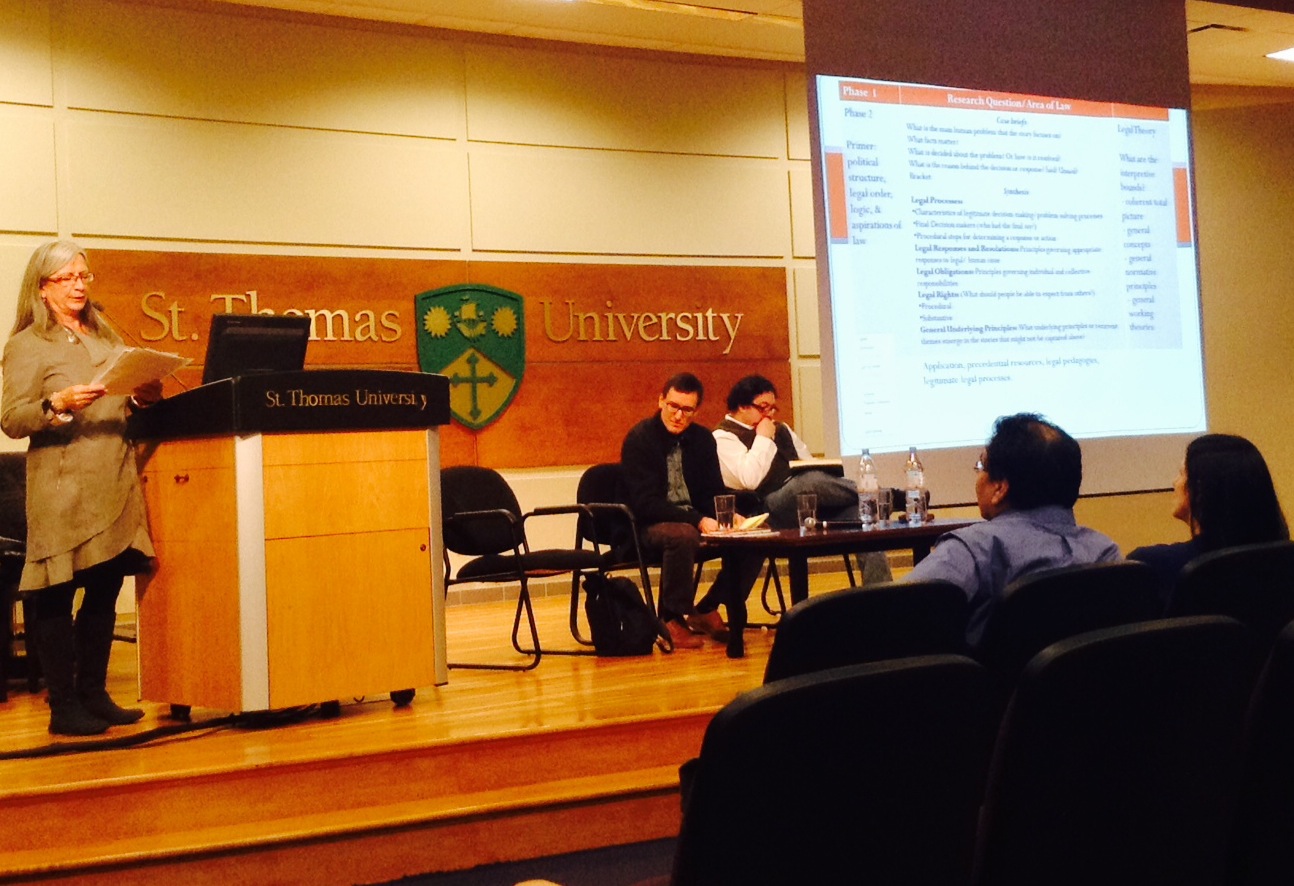
Arielle Dylan, a social work professor at St. Thomas University, and her research assistant, Bartholomew Smallboy organized a very stimulating panel discussion titled “Envisioning Indigenous Partnership: Promoting Reconciliation” on Thursday, April 10, 2014.
About 30 people attended the event held at Kinsella Auditorium and co-sponsored by the Social Sciences and Humanities Research Council Canada and the Urban Aboriginal Knowledge Network.
Three of Canada’s most distinguished speakers in the area of Indigenous law were brought to Fredericton to speak on this important topic: Val Napoleon, Law Foundation Professor of Aboriginal Justice and Governance at the University of Victoria, Gordon Christie, Director of Indigenous Legal Studies from the University of British Columbia, and Dale Turner, Associate Professor of Government and Native American Studies from Dartmouth College.
The three guests were welcomed to unceded Wolastoq territory by St. Thomas University’s Elder-in-Residence, Miigam’agan, a member of the Mi’kmaq Nation and Wabanaki Confederacy, and activist Judie Acquin-Miksovsky, from St. Mary’s First Nation.
All three panelists are members of Indigenous communities who study Indigenous law and identity in some way. Their perspective is one that is informed by lived experience as well as research. Napoleon is from the Salteau First Nation from Northeastern British Columbia. Christie’s mother is Inupiat-Inuvialuit, from the Western Arctic Region, and he grew up in Inuvik, Northwest Territories. An Anishnabi now working in the U.S., Dale Turner is also the author of This Is Not a Peace Pipe: Towards a Critical Indigenous Philosophy (University of Toronto Press, 2006).
Napoleon explained the unique method that she and her team of researchers are conducting in order to construct a body of Indigenous law. Her research looks to indigenous stories, legends and teachings for clues towards mode of comportment and decision-making processes in different Indigenous communities across Canada.
Not happy with simply gathering the stories, Napoleon and her team look to members of the communities for confirmation of the conclusions they reach. Napoleon hopes that by this process, some corpus of Indigenous legal practices can be constructed. She sees this as the first step to understanding Indigenous people’s circumstances. Napoleon’s work is practical but has profound implications for the construction of Indigenous legal orders.
Christie presented the landmark law cases that have established the basis for the legal relationship between the Indigenous people and the Crown, which governs the Canadian state. Christie discussed the Supreme Court of Canada decisions known as Sparrow (1990), Van der Peet (1996), Gladstone (1996), and Haida Nation (2014).
These decisions by Canada’s highest courts have shaped recent interactions and driven the need for “reconciliation.” They have effectively revealed that the Supreme Court schizophrenically dances between the rights of Indigenous communities while upholding Canadian laws and the Crown’s sovereignty.
Christie’s conclusions after his analysis of this complicated waltz is that there are three central forces that, in combination, have shaped decision-making since the incipit: racism, colonialism and capitalism.
Turner’s analysis started with a questioning of the concept of reconciliation, as represented in the Van der Peet decision, and giving an overview of the political situation of the last decades. In this period, Canada has gone from one extreme to the other in its position with respect to Indigenous peoples.
The infamous White Paper, or “Statement of the Government of Canada on Indian policy,” from 1969 (under then Minister of Indian Affairs Jean Chrétien, during Pierre Trudeau’s Liberal government), effectively advocated for the integration of Indigenous peoples into mainstream Canadian society. Then, in 1982, Indigenous peoples acquired “theoretical” group rights and protection of their treaty rights under Section 35 of the Canadian Constitution, repatriated that year.
Given this oscillation, and the subsequent Supreme Court decisions mentioned by Christie, Turner still sees hope in the desire of Indigenous peoples to defend their rights, learn and live. He also places great emphasis on the need to educate children and young people to change mentalities and alter the political relationship between Indigenous peoples and the state.
For more information about the scholars and their work: