• “I can’t believe I get to live in a place like this”: Deborah Carr
  • “Our rural roads are dangerous”: Cheryl Johnson
  • “Scarlet flowers in a messy garden:” Rick Roth
  • 2021 CUPE strike
  • About
    • History
    • Join us / Rejoignez-nous
  • Archives
  • Brian Beaton Annual Prize in Journalism for Justice / Le prix annuel de journalisme Brian Beaton pour la justice
  • Calendar
  • Comment soumettre votre article
  • Contact
  • Front Page
  • Garlic and optimism by Stephanie Coburn
  • google site verification – do not delete
  • Join the Co-op / Donate
  • Local Journalism Initiative
  • Markets and inter-generational goodness by Teri McMackin
  • Nuclear energy in New Brunswick
  • On hanging on and being hopeful: Deborah Carr
  • Our Team / Notre Équipe
  • Posts Page
  • Privacy policy
  • Share a Story
  • Subscribe/ S’abonner
  • The Brief / En Bref
  • The hills of Penobsquis by Beth Nixon
  • The NB debrief with Tobin Haley
  • Devenir membre / Faire un don
  • Donation Confirmation
  • Donation Failed
  • Donor Dashboard
NB Media Co-op
No Result
View All Result
No Result
View All Result
NB Media Co-op
No Result
View All Result
Home *Opinion*

Flexibilization damages the university: thoughts on the Mt. Allison strike

by Judith Weiss
April 3, 2020
in *Opinion*, Labour, Opinion
0
0
SHARES
0
VIEWS
MAFA_muffins
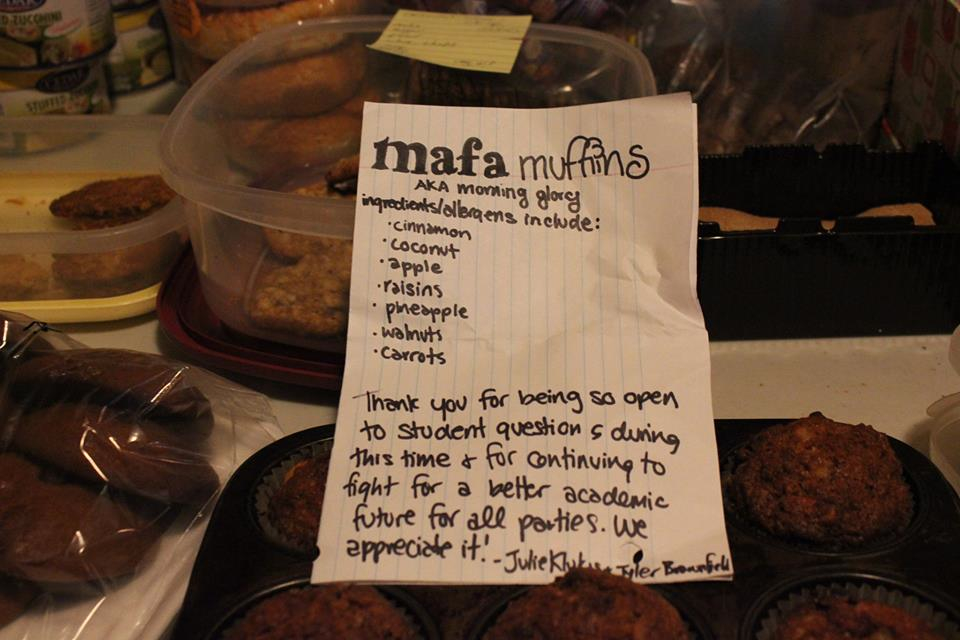
Mount Allison University students bring muffins and a message of solidarity to striking professors. Photo from the MAFA Facebook page.

Part-time faculty’s precarious jobs are the equivalent of casual labour, but a liberal arts university does not function like a widget-maker or a big box store. Why do “flexibilization” and increased executive decision-making, so prevalent in business today, not favour education, research or so-called competitiveness in recruiting good faculty and good students? Let us look at some ways in which this erroneous model is being imposed at Mount Allison.

The University hires excellent part-time faculty, but they receive inadequate compensation.

It expects good teachers, yet it does not compensate them for preparation time ahead of classes or pay them to stay and follow up with students and colleagues after finals.

It expects academic programs and departments to maintain their excellence, yet it does not offer them continuity or stability in the form of guaranteed teaching positions beyond a single semester or two. This is an obstacle in planning courses and departmental duties.

It expects departments to run efficiently and effectively, but because part-time faculty do not enjoy the same standing or have all the same responsibilities beyond the classroom as their full-time colleagues, departments end up short-handed and full-time faculty have increased workloads and less free time to help students with academic advice and career guidance. They have to teach larger classes and sometimes have to cancel courses with low enrollments, even if these may be needed for a student’s program. They might not be able to get to know their students well enough to write informed letters of reference.

It expects all faculty members to publish or to produce a substantive body of work in a creative field, but as working conditions are made more difficult it becomes harder for faculty to make significant contributions in the competitive fields of research beyond the University.

When “flexibilization” is invoked to replace full-time staff with part-time appointments based on enrollments alone, or to eliminate positions altogether, there can be lasting damage. The fact is that enrollments (a) tend to rise and fall in cycles over the years, and (b) they also depend on the due diligence of each program’s faculty to improve their offerings and to adapt – something that understaffed and harassed departments cannot be expected to accomplish adequately because of a lack of time for reflection and analysis.

The Mount Allison administrators are now seeking to enshrine in a new collective agreement the enhanced role of deans and provost in evaluating the merits of individuals, programs and departments, usurping the traditional role of faculty committees. And they want to do so without taking into account the conditions under which the academic programs and individual faculty are operating — conditions which the administration itself may have caused through its policies of attrition and arbitrary cuts and reductions.

The University promises prospective students a superior education, with low student-faculty ratios and excellent classes taught by dedicated faculty. What ratios? What quality of programs staffed by professors burdened with increased workloads, and of classes staffed by part-time instructors who lack proper preparation time and who live challenged by financial worries?

If the situation of both part-time and full-time faculty is not guaranteed to improve, the University will be less able to attract and retain promising faculty and students. Its shiny buildings, its four vice-presidents and three deans and its army of non-academic staff can hardly compensate for a well-supported teaching faculty secure in the collegial process that guarantees the quality of the University.

Judith Weiss is a Professor Emerita of Hispanic Studies at Mount Allison University.

Tags: educationlabourNew Brunswickslider

Recommended

No Content Available

Site Links

  • Log in
  • Entries feed
  • Comments feed
  • WordPress.org
  • “I can’t believe I get to live in a place like this”: Deborah Carr
  • “Our rural roads are dangerous”: Cheryl Johnson
  • “Scarlet flowers in a messy garden:” Rick Roth
  • 2021 CUPE strike
  • About
  • Archives
  • Brian Beaton Annual Prize in Journalism for Justice / Le prix annuel de journalisme Brian Beaton pour la justice
  • Calendar
  • Comment soumettre votre article
  • Contact
  • Front Page
  • Garlic and optimism by Stephanie Coburn
  • google site verification – do not delete
  • Join the Co-op / Donate
  • Local Journalism Initiative
  • Markets and inter-generational goodness by Teri McMackin
  • Nuclear energy in New Brunswick
  • On hanging on and being hopeful: Deborah Carr
  • Our Team / Notre Équipe
  • Posts Page
  • Privacy policy
  • Share a Story
  • Subscribe/ S’abonner
  • The Brief / En Bref
  • The hills of Penobsquis by Beth Nixon
  • The NB debrief with Tobin Haley
  • Devenir membre / Faire un don
  • Donation Confirmation
  • Donation Failed
  • Donor Dashboard

© 2026 JNews - Premium WordPress news & magazine theme by Jegtheme.

No Result
View All Result
  • “I can’t believe I get to live in a place like this”: Deborah Carr
  • “Our rural roads are dangerous”: Cheryl Johnson
  • “Scarlet flowers in a messy garden:” Rick Roth
  • 2021 CUPE strike
  • About
    • History
    • Join us / Rejoignez-nous
  • Archives
  • Brian Beaton Annual Prize in Journalism for Justice / Le prix annuel de journalisme Brian Beaton pour la justice
  • Calendar
  • Comment soumettre votre article
  • Contact
  • Front Page
  • Garlic and optimism by Stephanie Coburn
  • google site verification – do not delete
  • Join the Co-op / Donate
  • Local Journalism Initiative
  • Markets and inter-generational goodness by Teri McMackin
  • Nuclear energy in New Brunswick
  • On hanging on and being hopeful: Deborah Carr
  • Our Team / Notre Équipe
  • Posts Page
  • Privacy policy
  • Share a Story
  • Subscribe/ S’abonner
  • The Brief / En Bref
  • The hills of Penobsquis by Beth Nixon
  • The NB debrief with Tobin Haley
  • Devenir membre / Faire un don
  • Donation Confirmation
  • Donation Failed
  • Donor Dashboard

© 2026 JNews - Premium WordPress news & magazine theme by Jegtheme.

X
Did you like this article? Support the NB Media Co-op! Vous avez aimé cet article ? Soutenez la Coop Média NB !
Join/Donate