

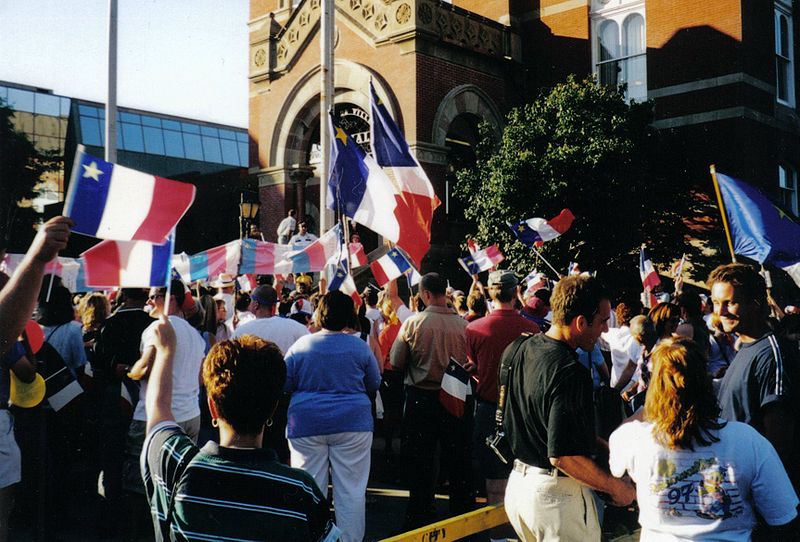
 Mid-August is one of my favourite stretches of summer, but not because of vacation time or the fact that the water at Parlee Beach is at its warming point. No, I enjoy this time of the year because it’s when our community celebrates National Acadian Day and Pride Week (this week in Moncton!).
At first glance, National Acadian Day and Pride Week may not seem related; after all, one is a single-day celebration of Acadian heritage and culture and the other is a week-long series of events focused on the LGBTQ community.
While the events may have different focuses and formats, they both do something incredibly important: they centre identities that continue to often be sidelined and discriminated against.
As a minority population (albeit a large and vibrant one), Acadians in our province must constantly struggle against cultural assimilation (the process through which Acadian culture would blend more and more with the dominant English culture until it disappears). Acadians also have to contend with claims that “reverse discrimination” against Anglophones is taking place in our province. We see these claims of “reverse discrimination” advanced by groups such as the Anglo Society of New Brunswick. The group is promoting, via their website, a Change.org petition that — beneath a poster reading “Equal Rights for N.B.’s English” — urges the provincial government to “Stop the hiring discrimination against citizens who speak only English.” The petition, which has over 5,000 supporters, argues against new civil service job postings that require bilingualism.
I understand the frustration that many job-seekers experience when it comes to applying for bilingual positions with limited French-language skills. However, to suggest that the root of this issue is reverse discrimination against the English is ludicrous. When we perceive an instance of reverse discrimination (instead of plain old discrimination), the implication is that a minority group (i.e. Francophones) are now oppressing a majority group (i.e. Anglophones). The flaw with this is, of course, is that minority groups do not have the power to oppress a majority group. Sure, individual members of a minority group might have discriminatory or prejudicial beliefs that they espouse and act on, but they don’t have the power to take those beliefs to an institutional level.
In the face of assimilation and accusations of creating inequality, the celebration of National Acadian Day becomes even more important and serves as a statement from Acadians that they refuse to be shamed or silenced. It’s also important that it’s not just Acadians who acknowledge the day; federal legislation also does. In 2003, Aug. 15 was recognized by Parliament through the National Acadian Day Act, which acknowledges that “for nearly 400 years, to the economic, cultural and social vitality of Canada,” that “it is in the interest of all Canadians to be able to share in the rich historical and cultural heritage of Acadians,” and that “it is important to encourage Acadians to be proud of their heritage.”
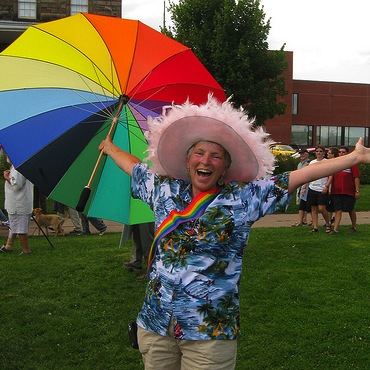
The refusal to be shamed or silenced is also a key component of Pride Week for members of the LGBTQ community. LGBTQ individuals continue to face discrimination and prejudice in a variety of forms that span from nearly imperceptible ‘micro-aggressions’ right through to deadly violence. In between those extremes, LGBTQ individuals face discrimination when it comes to housing, employment, health care, the justice system and more. Pride Week (particularly in larger cities, with larger scale celebrations) evokes discomfort in some, leading to questions as to why queer lives need to be “paraded” about and whether Pride helps advance LGBTQ equality. Here’s the thing: celebrating one’s queer existence in the face of historical and current homophobic oppression is a powerful, radical act. (I should note here that I chose to use the word ‘queer’ because I identify as such; my use of the word is part of a larger context in which oppressed identity groups reclaim and transform slurs.) The roots of Pride Weeks are also deeply political; the Pride movement began as a series of riots in New York City in 1969 in response to police suppression of and brutality against the LGBTQ community.
Clearly, National Acadian Day and Pride Week aren’t the same thing, nor do I think that the struggles that Acadians and LGBTQ persons face are the same. Generally, I don’t find that comparing one type of oppression to another is terribly useful (in fact, it can become downright divisive and perpetuate harm). What I do think is useful, however, is recognizing common themes in the strategies used to resist oppression, discrimination, and prejudice. It thrills me to no end to see two different identity groups in Greater Moncton — Acadians and LGBTQ persons — use public celebration as a form of resistance during the same time two-week period.
I love that both events have, at their core, an insistence that belonging to the group in question is worth celebrating.
Joyeux Quinze-Août and Happy Pride, Greater Moncton!
Beth Lyons is the associate director of YWCA Moncton. This article was first published by the Times & Transcript.