

It can hardly come as a surprise to anyone that governments – like corporations – employ spin to portray their actions in the best possible light (and to cast their opponents in the worst possible light). Nor is it news that many corporations – and the PR companies they employ – operate a revolving door for helpful politicians.
So, should it come as any surprise to learn, as Joyce Nelson reveals in the current issue of Watershed Sentinel, that Peter Kent was appointed as a senior lobbyist by PR giant Hill & Knowlton while he was running as a Conservative candidate in 2008?
Of course, Hill & Knowlton (the company behind Enbridge’s justifiably spoofed ‘Pathway to the Future’ ad campaign) had no way of knowing their man Kent would win his riding and be appointed as the Harper government’s environment minister in January 2011.
That said, they – and their various tar sands clients – must have been pleased with his opening salvo. As Nelson reports, within hours of his appointment Kent was telling CTV: “I’m not going to stand by while outsiders slander Canada, Canadian practices and values and our ethical oil products.”
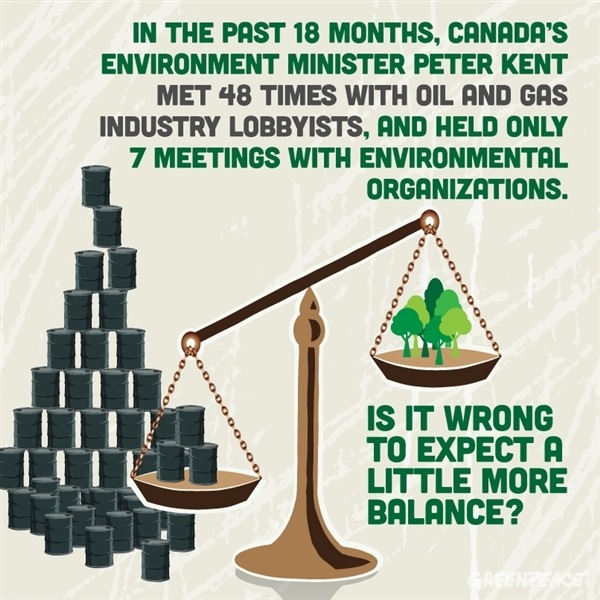
Kent’s performance to date has alarmed many environmentalists. They point out that the oil and gas industry already has its own minister (Joe Oliver) and that Kent’s real job, as Keith Stewart of Greenpeace has observed, “is to be the champion of environmental protection within government.”
Good luck with that.
In January 2013 Greenpeace passed on to CBC News a letter (obtained through an access to information request) which revealed that in late 2011, the oil and gas industry had requested changes be made to the National Energy Board Act, the Canadian Environmental Assessment Act, the Fisheries Act, the Navigable Waters Protection Act, the Species at Risk Act, and the Migratory Birds Convention Act.
As Nelson reports, the letter, addressed to Environment Minister Peter Kent and Natural Resources Minister Joe Oliver, came from a group called the Energy Framework Initiative (EFI), an umbrella group for major Canadian oil, gas and pipeline associations. “The purpose of our letter,” EFI wrote, “is to express our shared views on the near-term opportunities before the government to address regulatory reform for major energy industries in Canada.”
The letter continues: “The basic approach embodied in existing legislation is out-dated. At the heart of most existing legislation is a philosophy of prohibiting harm; ‘environmental’ legislation is almost entirely focused on preventing bad things from happening rather than enabling responsible outcomes. This results in a position of adversarial prohibition, rather than enabling collaborative conservation to achieve agreed goals.”
Well, yes, historically the focus of environmental legislation actually was environmental protection. Apparently no more.
At the time, the CBC reported: “Within ten months of the request the industry had almost everything it wanted.” Omnibus bills C-38 and C-45 rewrote the Canadian Environmental Assessment Act, gutted the Fisheries Act and the Navigable Waters Protection Act, and changed the National Energy Board Act and the Species at Risk Act.
Nelson observes: “In a real democracy, this incriminating letter would be a major news story across the country. But in the mock democracy of Harperland, the letter has effectively disappeared.” It’s difficult to disagree with her.
*Smoke and mirrors*
In 1953, Hill & Knowlton launched a PR offensive designed to convince government regulators and the public that there was no provable link between tobacco smoking and cancer. A team of supposedly independent scientists (bought and paid for by Hill & Knowlton on behalf of the tobacco industry) encouraged the public to “smoke without fear.”
As Nelson reports, “that same PR strategy (and often, the same group of scientists) has since been used to challenge scientific evidence on acid rain, destruction of the ozone layer, toxicity of DDT, second-hand smoke, and climate change – thereby delaying regulatory action, muddying the science, and confusing the public on environmental issues. Under this strategy, established science becomes just another competing ‘side’ in an issue, while corporate financed scientific studies or bought scientific opinion are granted equal weight by the media.
“But in Canada, that time-tested Hill & Knowlton PR strategy is being taken much further by the Harper cabinet itself, including Peter Kent, with government scientists being muzzled, fired en masse, and even their research facilities dismantled and destroyed.”
The line between spin doctoring and propaganda (assuming there is one) can be so fine as to appear invisible.
Joseph Goebbels once infamously stated: “If you tell a lie big enough and keep repeating it, people will eventually come to believe it.” The Nazi propaganda minister went on to say, even more chillingly: “The lie can be maintained only for such time as the State can shield the people from the political, economic and/or military consequences of the lie. It thus becomes vitally important for the State to use all of its powers to repress dissent, for the truth is the mortal enemy of the lie, and thus by extension, the truth is the greatest enemy of the State.” (Emphasis added.)
Welcome to Harperland.
Miranda Holmes is an associate editor of Watershed Sentinel magazine. To read Joyce Nelson’s exposé of Hill and Knowlton’s role in promoting the tar sands, go to www.watershedsentinel.ca/content/enbridges-pr-firm-hill-and-knowlton-minister-environment-connection.