• “I can’t believe I get to live in a place like this”: Deborah Carr
  • “Our rural roads are dangerous”: Cheryl Johnson
  • “Scarlet flowers in a messy garden:” Rick Roth
  • 2021 CUPE strike
  • About
    • History
    • Join us / Rejoignez-nous
  • Archives
  • Brian Beaton Annual Prize in Journalism for Justice / Le prix annuel de journalisme Brian Beaton pour la justice
  • Calendar
  • Comment soumettre votre article
  • Contact
  • Front Page
  • Garlic and optimism by Stephanie Coburn
  • google site verification – do not delete
  • Join the Co-op / Donate
  • Local Journalism Initiative
  • Markets and inter-generational goodness by Teri McMackin
  • Nuclear energy in New Brunswick
  • On hanging on and being hopeful: Deborah Carr
  • Our Team / Notre Équipe
  • Posts Page
  • Privacy policy
  • Share a Story
  • Subscribe/ S’abonner
  • The Brief / En Bref
  • The hills of Penobsquis by Beth Nixon
  • The NB debrief with Tobin Haley
  • Devenir membre / Faire un don
  • Donation Confirmation
  • Donation Failed
  • Donor Dashboard
NB Media Co-op
No Result
View All Result
No Result
View All Result
NB Media Co-op
No Result
View All Result
Home Environment

Passing up responsibility: fishermen worried about pesticide use in aquaculture

by Ethan Haslett
December 26, 2019
in Environment, New Brunswick, Rural
0
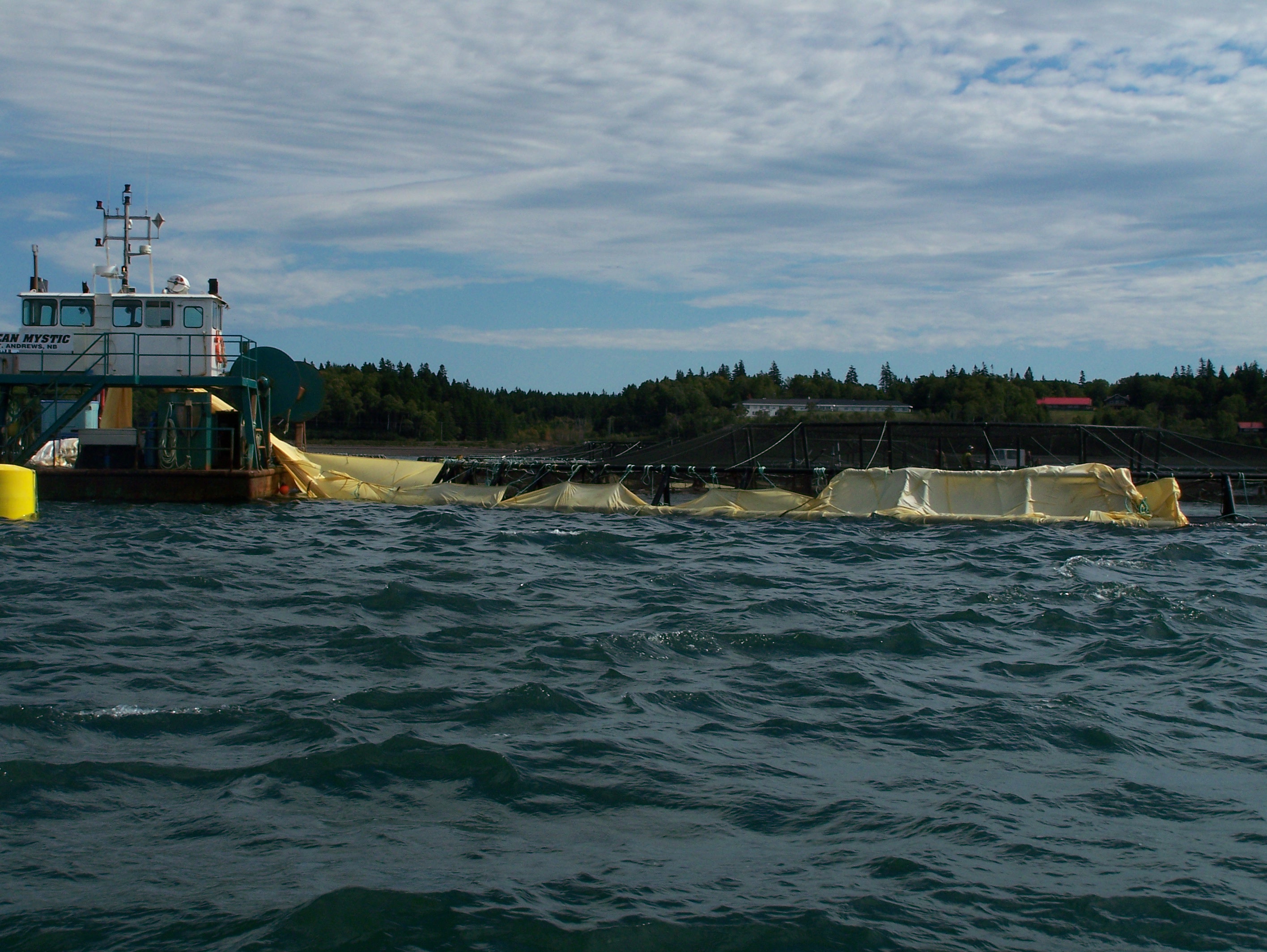
Tarps being placed around a salmon pen off Campobello Island. Tarps like these are used for some pesticide treatment on salmon farms. Photo - David Thompson
0
SHARES
0
VIEWS

Tarps being placed around a salmon pen off Campobello Island. Tarps like these are used for some pesticide treatment on salmon farms. Photo - David ThompsonPesticide use has always been a concern to those who work with them on a daily basis. They can affect wildlife and entire ecosystems, which is why some fishermen in New Brunswick are worried about new government regulations.

New regulations being proposed would essentially remove Environment Canada’s role in restricting use of pesticides approved by Health Canada in aquaculture such as open net-pen salmon farming. The fishermen are concerned about the potential negative side-effects of chemicals.

Matthew Abbott is the Fundy Baykeeper with the Conservation Council. He is concerned by the potential for greater pesticide use if the regulations are passed. “Environment Canada is the only agency we’ve seen take action to curb pesticide use,” says Abbott.

Sea lice are a natural parasite on salmon and other fish. These pests are more common in areas where numerous fish are kept close together. That’s why chemicals and pesticides are used in the water at some salmon farms, to kill off harmful parasites.

The regulations would allow pesticides to be used after Health Canada gives the approval, effectively exempting Health Canada approved pesticides from the Fisheries Act. Abbott says pesticide application can cause harm or kill other creatures. “With the bath treatment, the pesticides are put directly into the water. It’s not filtered out and it’s left to flow downstream. And the problem is that the chemicals used can kill crustaceans. In many marine ecosystems, like the Bay of Fundy, crustaceans are the base of the food chain,” said Abbott.

In an official news release, Fisheries and Oceans Canada state that, “The federal government is committed to avoiding duplicative administrative requirements, while ensuring that legislative environmental protection objectives are met.”

The regulatory changes are not pleasing for fishermen who feel the impact of ongoing pesticide use could have repercussions over time, especially on larval and young lobster. Frank Stanek, the Manager of Media Relations for Fisheries and Oceans Canada, disagrees. Stanek says, “Changes are being considered, in collaboration with federal and provincial governments, with the intention that they will benefit all public interests through strong environmental management measures in place to protect aquatic ecosystems, the health of farmed and wild fish populations.”

For people who rely on the ocean to support their family it’s an issue that’s hitting home. Abbott and others are wondering why non-chemical solutions are not being considered. “We’ve just accepted that we’re going to have sea lice and that we have to use chemicals,” says Abbott.

He believes that there needs to be major changes to how open net-pen salmon farms are managed. “Instead of eliminating sites in areas with persistent sea lice problems and facilitating a transition to growing salmon in land-based closed containment. The new regulations merely facilitate environmentally irresponsible practices,” suggests Abbott.

Public input is currently being reviewed and considered in the revision stage of the regulation draft. Abbott and others fear that it’s only a matter of time before the regulation is passed.

Tags: CCNBConservation Council NB

Recommended

No Content Available

Site Links

  • Log in
  • Entries feed
  • Comments feed
  • WordPress.org
  • “I can’t believe I get to live in a place like this”: Deborah Carr
  • “Our rural roads are dangerous”: Cheryl Johnson
  • “Scarlet flowers in a messy garden:” Rick Roth
  • 2021 CUPE strike
  • About
  • Archives
  • Brian Beaton Annual Prize in Journalism for Justice / Le prix annuel de journalisme Brian Beaton pour la justice
  • Calendar
  • Comment soumettre votre article
  • Contact
  • Front Page
  • Garlic and optimism by Stephanie Coburn
  • google site verification – do not delete
  • Join the Co-op / Donate
  • Local Journalism Initiative
  • Markets and inter-generational goodness by Teri McMackin
  • Nuclear energy in New Brunswick
  • On hanging on and being hopeful: Deborah Carr
  • Our Team / Notre Équipe
  • Posts Page
  • Privacy policy
  • Share a Story
  • Subscribe/ S’abonner
  • The Brief / En Bref
  • The hills of Penobsquis by Beth Nixon
  • The NB debrief with Tobin Haley
  • Devenir membre / Faire un don
  • Donation Confirmation
  • Donation Failed
  • Donor Dashboard

© 2026 JNews - Premium WordPress news & magazine theme by Jegtheme.

No Result
View All Result
  • “I can’t believe I get to live in a place like this”: Deborah Carr
  • “Our rural roads are dangerous”: Cheryl Johnson
  • “Scarlet flowers in a messy garden:” Rick Roth
  • 2021 CUPE strike
  • About
    • History
    • Join us / Rejoignez-nous
  • Archives
  • Brian Beaton Annual Prize in Journalism for Justice / Le prix annuel de journalisme Brian Beaton pour la justice
  • Calendar
  • Comment soumettre votre article
  • Contact
  • Front Page
  • Garlic and optimism by Stephanie Coburn
  • google site verification – do not delete
  • Join the Co-op / Donate
  • Local Journalism Initiative
  • Markets and inter-generational goodness by Teri McMackin
  • Nuclear energy in New Brunswick
  • On hanging on and being hopeful: Deborah Carr
  • Our Team / Notre Équipe
  • Posts Page
  • Privacy policy
  • Share a Story
  • Subscribe/ S’abonner
  • The Brief / En Bref
  • The hills of Penobsquis by Beth Nixon
  • The NB debrief with Tobin Haley
  • Devenir membre / Faire un don
  • Donation Confirmation
  • Donation Failed
  • Donor Dashboard

© 2026 JNews - Premium WordPress news & magazine theme by Jegtheme.

X
Did you like this article? Support the NB Media Co-op! Vous avez aimé cet article ? Soutenez la Coop Média NB !
Join/Donate