

The New Brunswick government announced this week that they will abolish the New Brunswick Advisory Council on the Status of Women, an arms length agency to the government that provides a number of services to women across the province. The Council advises the government on policies that affect women. They run frequent Lunch and Learns on topics of concern to women and send a popular weekly email with stats, news and event notices pertinent to women.
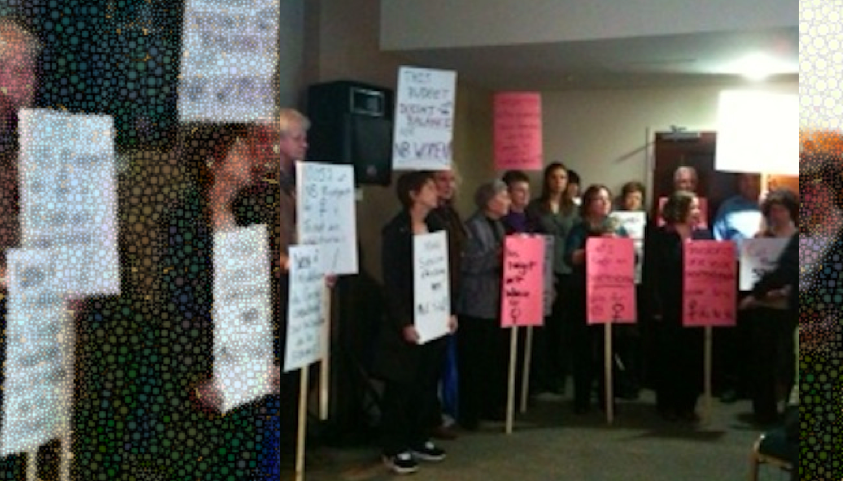
Still reeling from the news, the Council launched a web-based listing of sites and landmarks of importance to the history of women in the province yesterday, March 24, 2011, in Saint John. A group of people gathered with signs at the event to show their support for the Council.
Lisa Sproull, a woman from Fredericton who appreciates the work of the Council notes, “In 2010, unionized women made $0.22 less per hour than unionized men in New Brunswick and non-unionized women made $3.55 less per hour than non-unionized men, according to the N.B. Advisory Council on the Status of Women. To combat this distressing statistic, the New Brunswick government will be eliminating the N.B. Advisory Council on the Status of Women.”
The government argues that the Council provides the same services as the Women’s Issues Branch. The Council argues their work does not overlap and that they remain an objective distance from the government in order to evaluate government programs critically. Because of its direct relationship with the government, the Women’s Issues Branch cannot have the same independent influence.
The Council’s supporters are arguing that the Alward government is cutting their funding not for financial reasons, but for ideological ones. The Council’s work includes advancing reproductive rights and pay equity in the province.
Marilyn MacCormack, the Chair of the N.B. Coalition for Pay Equity, is asking the Premier to reconsider his decision to abolish the Advisory Council on the Status of Women. “The Advisory Council plays a unique role. It is an arms-length agency, independent from the government, respected by everyone in New Brunswick. It brings women’s concerns and issues in the public space, shares it with the government and advises the minister. Its abolition would represent the end of this independent voice,” says MacCormack.
The government of New Brunswick is slashing the Advisory Council’s budget of $418,000 and adding $76,000 to the Women’s Issues Branch of the Executive Council Office. MacCormack asks, “Isn’t the women’s perspective worth $342,000 to the government?”
The N.B. Coalition for Pay Equity has also been the victim of funding cuts. In 2010, the Harper government refused to renew funding to the Coalition. They have been forced to fundraise to continue their advocacy for pay equity in the public and private sectors in the province.
The Coalition welcomed the Finance Minister’s expected budget announcement of pay increases for workers in home-support agencies and special care homes but remain concerned whether the increases will be sufficient to reach pay equity. The Coalition was alarmed that pay adjustments were not announced for workers in child care, group homes and transition houses.
“The provincial government should base its economic decisions on the principles of equity, economic security, sustainability and democracy,” says Michel Boudreau for the Economic Equity Working Group.
The Economic Equity Working Group, representing a number of citizens, organizations and unions concerned about the province’s future directions to solve the fiscal imbalance and debt, wants the new Alward government to abolish the regressive income and corporate tax reforms introduced by the previous Liberal Graham government in 2009.
“The government will get the highest economic returns by investing in people, not by cutting taxes”, says Boudreau. “Evidence shows that investments made in child care services, health care, social services, education, and publicly owned and operated infrastructure give the highest economic returns, measured both in terms of increases to GDP and job creation.”
Organizations working on women’s equality and empowerment across Canada are under attack. The federal government released their budget on the same day as the Alward Conservatives on March 22, 2011. According to Irene Mathyssen, the NDP Women’s Critic, women have yet again been let down.
“Women in Canada make up 51% of the population yet are still fighting for equality. Women earn less money than men and are more likely to be living under the poverty line. Aboriginal women, senior women and visible minority women are even more at risk for poverty. Token tax cuts included in the budget are of no help to those living from paycheque to paycheque or having no paycheque at all. Tax breaks are for the rich and those included in this budget will not have a significant impact on the pocket books of the average Canadian family,” says Matthysen.
Mathyssen lists many omissions in the Harper Conservative’s budget including a national child care program, increased access to Employment Insurance for part-time workers and those needing to take time off to take care of dependents, improvements to parental and maternity benefits, full pay equity in the federal public services, funding for shelters and transition houses for women who are victims of domestic violence, financial support for native women’s efforts to develop healing centres and educational and training opportunities, including those that target the root causes of violence and violence directed at sex trade workers.
For more information, visit the campaign website to save the N.B. Advisory Council on the Status of Women or contact: advisoryactionconseil@gmail.com
Tracy Glynn is on the board of the NB Media Co-op.