

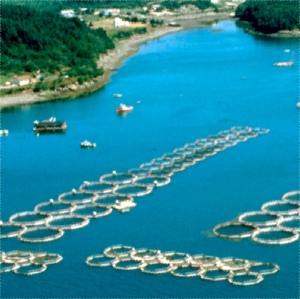
 In the recent province wide coverage of illegal pesticide use in the Bay of Fundy, aquaculture representatives have used a number of clever turns of phrase to divert our attention from the serious situation at hand and suggest that the dumping of pesticides to control sea lice in salmon cages is harmless. In a radio interview last week, Pamela Parker of the New Brunswick Salmon Grower’s Association referred to the cocktail of legal pesticides used on salmon farms as “medicine.” Chemicals designed to kill crustaceans should hardly be described as such. Take for instance SALMOSAN®, a legal pesticide approved for use by the New Brunswick aquaculture industry. The warning label explicitly refers to the product as poison. The label also details a long list of precautions needed to avoid exposure, as well as suggesting that no recreational activities be carried out “in treated water near fish farm areas … until post treatment tidal flushing occurs.” Given that we should avoid even being in water close to a treated site, SALMOSAN® hardly seems “medicinal.” Instead of acknowledging that it is due to industry practices (like growing too many fish per site and having too many sites in the same area) that lead to the sea lice infestations, the industry pretends that more chemicals are the answer to the problem.
Ms. Parker also referred to salmon farming techniques as “natural.” Atlantic Salmon, in their natural state, can travel more than 4000 km at sea (according to the Atlantic Salmon Federation) and experience diverse marine ecosystems throughout their life cycle. Farmed salmon are, in contrast, confined first to hatcheries and then to net pens. While in these enclosed environments they are fed wild-caught fish along with a mixture of antibiotics, pesticides and in-feed colour additives to give them the “natural” salmon pink colour. It leaves one wondering just what Ms. Parker means when she claims that the New Brunswick aquaculture industry uses “natural” techniques?
The Bay of Fundy is an awe inspiring, dynamic and diverse marine ecosystem as well as an important food basket and economic resource to fishing communities. It is critical that such a valuable resource be protected. The use of pesticides, both illegal and legal, on salmon farms threatens this shared resource in the interests of short-term gain for one industry. If we want a healthy and diverse Bay of Fundy for ourselves and future generations we need to ensure that poisons, for that’s what pesticides designed to kill crustaceans are, are no longer allowed to be dumped into our shared waters. Environment Canada is investigating the use of illegal pesticides by the aquaculture industry. While this is a good first step to establishing exactly what is being dumped into our Bay, we need a moratorium on all pesticide usage, legal as well as illegal, and regulation that ensures the aquaculture industry operates in ways that do not destroy the marine environment in which they grow their fish.