

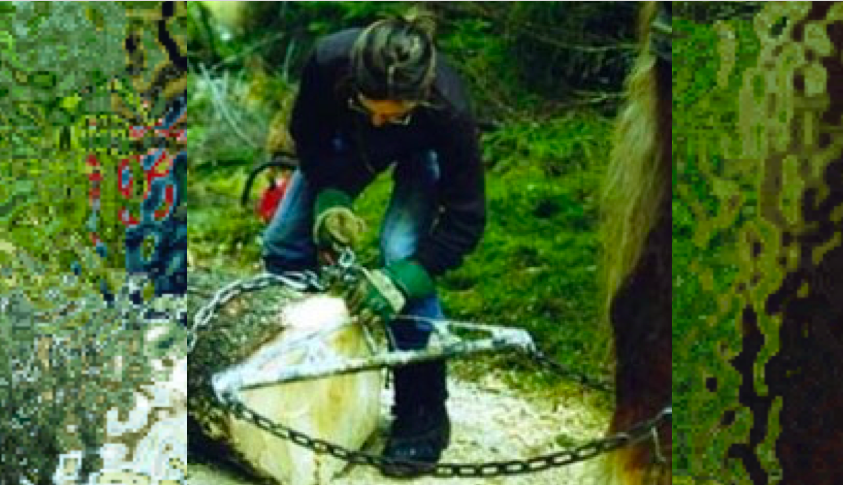
Sarah Teitelbaum, a PhD candidate studying community forestry at the Faculty of Forestry and Environmental Management at the University of New Brunswick, sees hope in the model of community forestry, which aims to bridge the gap between sustainable livelihoods and healthy forests. She lists the characteristics she uses to define community forestry thusly: “a public forest area; Crown land but also municipal land; managed by the community; more than 50 per cent decision-making by the community; a working forest, with timber harvesting as one of the activities, for the benefit of the community.” Teitelbaum found 116 community forests across Canada that conform to this definition.
Many of these community forests are found in Southern Ontario and Quebec. Teitelbaum also found a vibrant community forestry movement in British Columbia with active community forestry pilot projects.
Teitelbaum’s survey results show that the bulk of community forests are mostly small-scale and relatively young; 74 out of the 116 community forests are five to 10 years old. “From my experience, community forestry is not a simple enterprise. There is room for success but there is also room for failure,” she says. “They have to work under the same market conditions as forest companies, but often they are smaller.”
While New Brunswickers are ineligible for a license to cut wood from public land, private woodlot owners struggle to compete against the public wood cut by private multinationals. “To make a living, we need stable access to markets,” says Clark. “In 1982, a social contract was struck between woodlot owners, the wood-using industries and the government that said private woodlot owners would get first access to markets before Crown wood. In 1992, Frank McKenna betrayed that trust and took away our right to sell wood to the sawmills first.”
Clark proposes changing the licensing system to provide first access to public wood to companies with more employment per cubic-metre harvested. A ‘low value, high volume’ forestry vacuum has sucked away jobs in the forests of New Brunswick. Community forestry has the potential to turn the tide in New Brunswick with more people employed in the business of diverse forest products of high value, but with a smaller ecological footprint on the forest.
Rural communities in New Brunswick are desperate to revitalize their economies after waves of job losses in traditional sectors such as forestry and fisheries. Dr. Susan Machum, a professor in the Department of Sociology at St. Thomas University and Canada Research Chair in Rural Social Justice, stresses the need for communities to develop a vision for their future. “What kind of rural communities do we want?” she asks. “Do we want them [only] to be places where people sleep? [Because] this seems to be the vision of the Self-Sufficiency Task Force that tells us we need good superhighways to get people out…Or do we want communities where people are both able to live and work?”
The village of McAdam and six other municipalities in southwestern New Brunswick had a vision for the future. Guided by this vision, they developed the St. Croix community forest plan with a 51-member advisory board that included representatives from local government, conservation groups, recreational groups and industry. “That plan was an opportunity for us to make money,” says Frank Carroll, mayor of McAdam. “It was also an opportunity for the province of New Brunswick not to spend any.” The plan did not ask for any capital assets, but only for a $1 million loan guarantee to support the $2 million already committed by the local communities. Despite this, the plan was rejected by the provincial government and now collects dust on the mayor’s shelf.
A recent Supreme Court decision that unanimously upheld the Aboriginal right to log Crown lands for domestic purposes may open the door for a new model of forest management in New Brunswick. “In the upcoming months, I anticipate our community meeting with the government to discuss next steps,” said Brad Paul, a councillor at St. Mary’s First Nation.
Andrea Bear Nicholas, a Maliseet historian and professor in the Department of Native Studies at St. Thomas University notes: “It was ridiculous to win the right to use wood off land we never sold. We really did not win anything. We never took any of these cases to court. We were taken to court.”
Tracy Glynn is a writer and editor with the NB Media Co-op.